
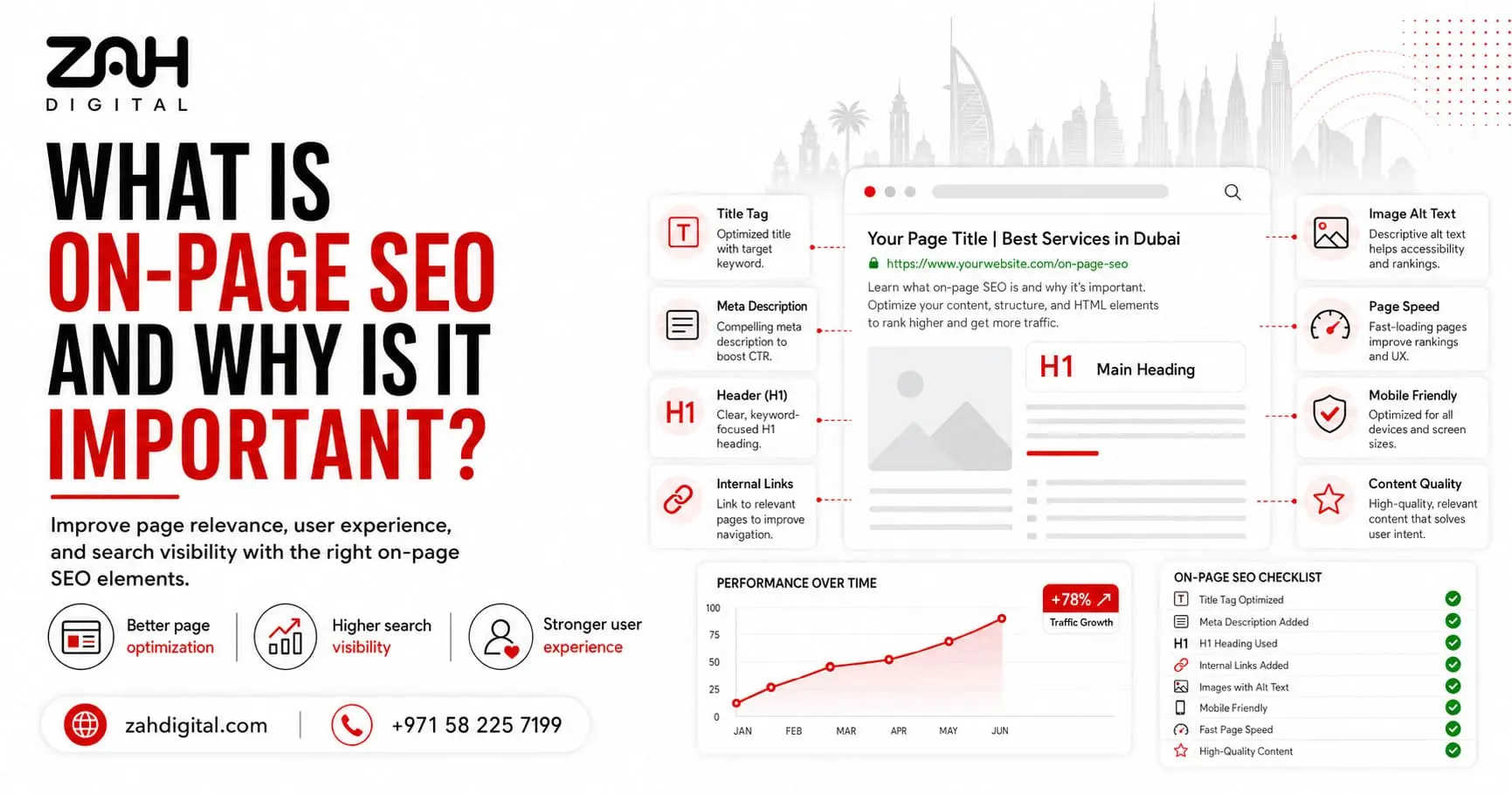
On-page SEO is the process of improving individual website pages. So they rank more in search results. Also provide a better experience for visitors. It will cover everything users can see on a page. Like headings. Written content and images. As well as behind-the-scenes elements. Like meta tags. URLs and internal links.
On-page SEO will help search engines understand three things. What your page discusses. Who it can help. Also whether it deserves visibility for a particular search query.
A good optimisation will not be about inserting the same keyword into every paragraph. But it requires a thoughtful balance between relevance and readability. Structure and intent. When a page answers the right question clearly. Both users and search engines will benefit.
Key Elements of On-Page SEO
Several connected elements will influence the performance of a webpage. So every effective on-page optimisation strategy must address the following areas.
Title Tags and Meta Descriptions
A title tag will tell search engines and users what the page is about. The meta description will provide a brief preview of the content. Though a meta description will not directly guarantee higher rankings. Persuasive wording will improve clicks from search results.
Header Tags
H1, H2 and H3 tags will organise information into clear sections. So readers can scan the page quickly. While search engines will identify the main topic and supporting ideas.
Keyword Placement
Strategic keyword optimisation will place relevant phrases in titles. Headings. Introductory paragraphs and supporting content. However, keywords must fit naturally. Forced repetition will reduce readability. This will weaken the page. Rather than strengthen it.
Internal Linking
Internal links will guide visitors towards related pages. Also help search engines discover important content. A service page about local SEO will link to pages about Google Business Profile management. Or location-based content.
Image Optimisation
Large and uncompressed images will slow down a website. So images must use suitable file formats. Descriptive filenames. Also meaningful alternative text. Proper optimisation will improve accessibility.
URL Structure
Short and descriptive URLs are easier to understand and share. For example, /on-page-seo-services/ communicates more value. Than a long address filled with random numbers. Or unnecessary folders.
Content Quality
Strong content optimisation focuses on search intent, originality and usefulness. Moreover, the content should answer practical questions instead of simply filling space with keywords.
User Experience and Technical Foundations
Page speed. Mobile usability. Layout stability. Also navigation will contribute to user experience SEO. While many of these areas will overlap with technical SEO. They directly influence how visitors will interact with an individual page. Get details on SEO Service in Dubai.
Why On-Page SEO Matters for Business Growth
Higher visibility will mean little when visitors do not find the information they need. On-page SEO can connect rankings with conversion. By aligning each page with a clear search purpose.
Someone searching for “SEO services in Dubai” will probably want to compare agencies. Services and expertise. So a well-optimised agency page must explain the service. Address common concerns. Build trust. Also offer a straightforward next step.
Effective on-page SEO will help businesses:
- Attract more relevant organic traffic
- Improve engagement and time on the website
- Generate qualified enquiries
- Strengthen topical authority
- Support local and service-based searches
- Make content easier for AI search platforms to interpret
Search algorithms may evolve, but useful, clearly structured pages remain central search engine ranking factors. On-page work will form the foundation of nearly every sustainable SEO campaign.
On-Page SEO vs Off-Page SEO
Both approaches support organic growth. However, they focus on different areas.
SEO Area | On-Page SEO | Off-Page SEO |
Main focus | Optimising website pages | Building authority outside the website |
Common activities | Content, headings, URLs, internal links and meta tags | Backlinks, digital PR, citations and brand mentions |
Level of control | High | Limited or shared |
Primary goal | Improve relevance and usability | Improve authority and credibility |
Typical timeframe | Changes can be implemented quickly | Results often build gradually |
Example | Improving a service page for a target query | Earning a link from a respected industry website |
Neither replaces the other. On-page SEO will create a page worth ranking. While off-page SEO will help establish confidence in that page. Looking for a AI and AEO Optimization Agency in Dubai?
Common On-Page SEO Mistakes to Avoid
One common mistake will involve writing for algorithms. Instead of people. Keyword-heavy text may technically mention the right topic, yet it often fails to persuade real visitors.
Other problems include duplicate title tags, missing headings, vague URLs, oversized images and weak internal linking. In addition, many businesses publish several pages that target the same search phrase. As a result, those pages may compete against each other.
Ignoring search intent creates another major issue. A detailed educational article will not satisfy someone ready to request a quotation. Therefore, the format and message must match the user’s stage in the buying journey.
Related Services:
» CRO & Funnel Optimization Service in Dubai
» Social Media Marketing Service in Dubai
» Website Development Service in Dubai
» Performance Marketing Agency in Dubai
How ZAH DIGITAL Approaches On-Page SEO
At ZAH DIGITAL. We never rely on one-size-fits-all checklists. But we examine the business. Competitors. Audience. Also search landscape. Before making recommendations.
Our approach will include keyword and intent research. Page mapping. Metadata refinement. Content restructuring. Internal linking. Also conversion-focused improvements. We will review mobile usability. Page speed. Also other technical signals that affect page performance.
We also follow practical SEO best practices for AEO and GEO. This means using direct answers. Descriptive headings. Concise definitions. Natural language. Also well-organised supporting information. Search engines. Voice assistants. Also generative AI platforms will interpret the page more accurately.
Related Articles:
» How Voice Search Is Changing Local SEO?
» How Long Does SEO Take to Show Results?
» Local SEO vs Traditional SEO: Which One Works Better in Dubai?
» How SEO Brings Qualified Leads to Your Business?
» AEO vs SEO: What Is the Difference?
Build Stronger Pages with ZAH DIGITAL
On-page SEO will give your website a clear purpose. It will help search engines understand your services. It helps potential customers find reliable answers. Also helps every important page work harder for your business.
Are you ready to improve your rankings without sacrificing readability or user experience? Contact ZAH DIGITAL. For professional on-page SEO services built around your market. Goals and customers.
FAQs: What Is On-Page SEO and Why Is It Important?
On-page SEO will mean improving the content. Structure and HTML elements of a webpage. To help it rank in search engines. It will include titles. Headings. Keywords. Internal links. Images. URLs and page quality. The aim will be to make each page useful for visitors. Also understandable to search platforms.
On-page SEO will help search engines identify the purpose. Also relevance of a webpage. It will improve readability. Navigation and user experience. When properly implemented. It will increase qualified organic traffic. Support stronger rankings. Also encourage more visitors to contact. Purchase from or engage with a business.
Important factors will include high-quality content. Search intent. Title tags. Headings. Internal links. Mobile usability. Page speed. URL structure and image optimisation. But no single factor will work alone. The strongest results will come from combining relevance and technical quality. Also a clear user-focused experience.
Keyword optimisation will involve selecting relevant search phrases. Also placing them naturally in strategic areas. This includes the title. Headings. Introduction. Body copy and metadata. It also includes using related terms and answering connected questions. Effective optimisation will improve context. Without repeating keywords. So frequently that the content becomes awkward.
On-page SEO will focus mainly on individual pages. This includes content. Headings. URLs. Metadata and internal links. Technical SEO will focus on website-wide systems. Like crawling. Indexing. Site architecture. Structured data and server performance. Both areas will overlap in page speed. Mobile usability. Also overall user experience.
Some improvements like better click-through rates. Or visitor engagement. This will appear relatively quickly. Ranking changes will usually take longer. Because search engines will need to crawl. Process. Also reassess the page. Competition. Website authority. Content quality. Also the size of the optimisation project. This will all influence the timeline.
Yes. Local businesses will optimise service pages. With relevant locations. Clear contact details. Locally focused content. Also links to supporting pages. But local SEO will depend on Google Business Profile optimisation. Reviews. Citations and proximity. On-page improvements will strengthen the website portion of the overall local search strategy.
Important pages must be reviewed. Whenever services and customer needs. Search behaviour or competing results change. Many businesses will benefit. From checking key pages every three to six months. But high-priority pages will require more frequent reviews. Especially when rankings fall. Or the information becomes inaccurate.
Meta descriptions will not be treated as a direct ranking signal. A clear and persuasive description will encourage more people to click the search result. A stronger click-through rate will increase traffic. It helps ensure users understand what they will find. Before opening the webpage.
SEO-friendly content will match search intent. Answer questions clearly. Also use a logical structure. It will include natural keywords. Helpful headings. Internal links. Also accurate information. It will provide genuine value. Search-friendly writing must sound useful. Also convincing to a human reader. Rather than written solely for an algorithm.
No. Initial optimisation will create a strong foundation. But websites and search results will continue to change. Competitors will publish new content. Customer questions evolve. Also technical problems will appear. So businesses must monitor important pages. Update outdated sections. Also refine them. According to performance data.
ZAH DIGITAL will combine search strategy. Content improvement. Technical understanding. Also conversion-focused copywriting. Instead of applying generic changes. The team will align each page with the business. Target audience. Also search intent. This approach will help create pages. That can attract visibility. While also encouraging meaningful customer action.