A keyword can attract thousands of searches and still bring almost no business value. Why? Because traffic alone doesn’t create results. The content must match what the searcher actually wants to find.
That expectation is known as search intent. When your page satisfies it clearly and quickly, visitors stay longer, engage with the content and move closer to taking action. When the page misses the intent. Even strong backlinks. Also careful keyword placement will not save its rankings.
What Is Search Intent?
Search intent describes the main purpose behind a Google search. It answers a simple question: what does the user hope to achieve after entering a keyword?
For example, someone searching “how does local SEO work?” wants an explanation. Meanwhile, a person typing “local SEO agency in Dubai” is likely looking for a service provider. Although both searches relate to SEO, they require completely different pages.
Therefore, effective search intent SEO goes beyond adding keywords. It focuses on the searcher’s expectations, preferred content format and likely next step.
Types of Search Intent
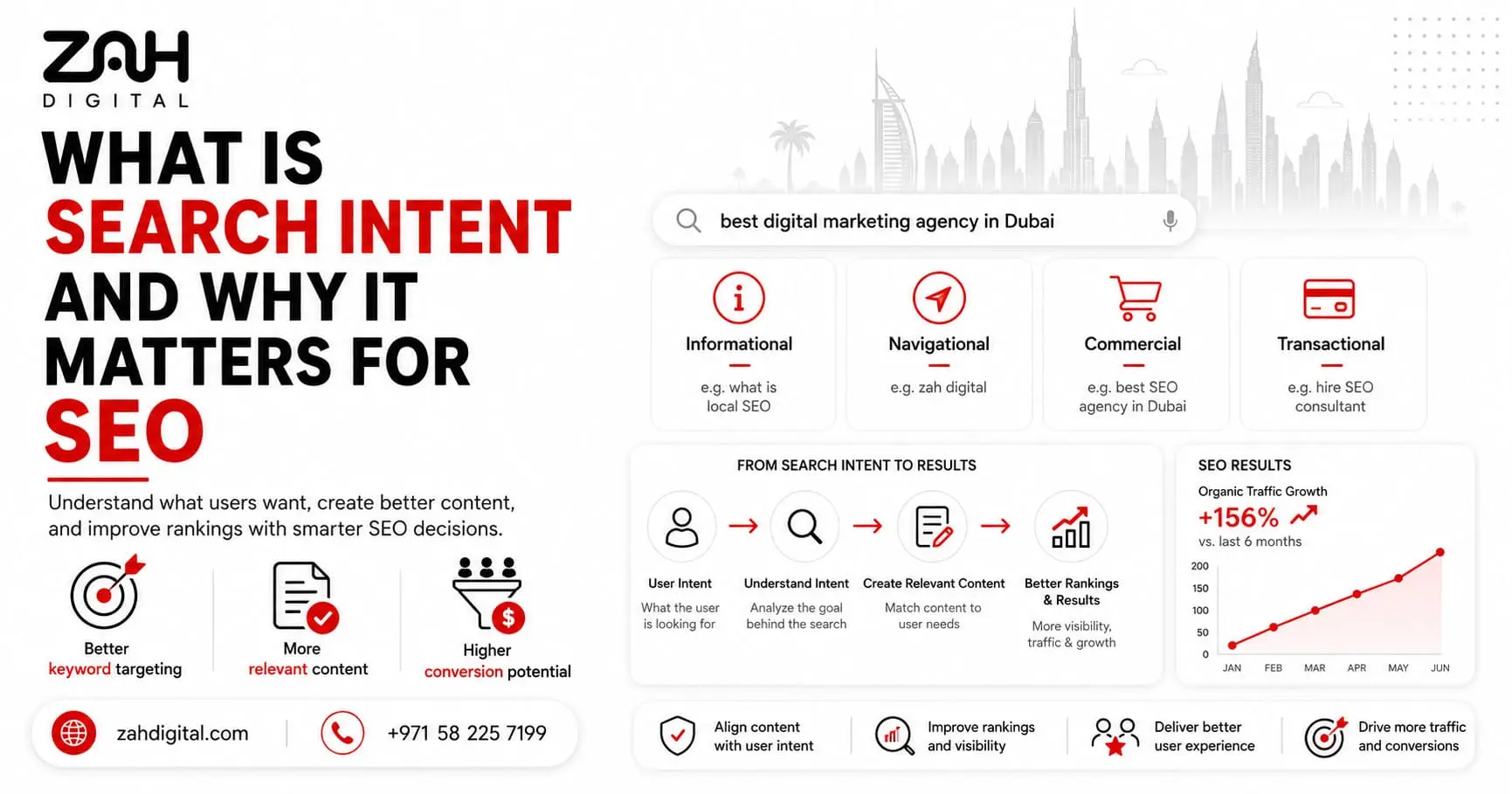
Most keyword searches fall into four broad categories.
Type of search intent | User goal | Example keyword | Best content format |
Navigational | Reach a specific website or page | “ZAH DIGITAL SEO services” | Brand page, login page or contact page |
Informational | Learn or understand something | “What is search intent?” | Blog article, guide, checklist or video |
Commercial investigation | Compare available choices | “Best SEO agencies in Dubai” | Comparison page, case study or service guide |
Transactional | Complete an action or purchase | “Hire SEO consultant Dubai” | Service page, landing page or booking form |
Understanding these types of search intent. This will help businesses choose the right page. Before they begin writing. This step can prevent a common mistake. Trying to rank a sales page for a keyword. That Google treats as informational.
Why Search Intent Matters for SEO Rankings
Google wants to provide results. That solves the searcher’s problem. So pages that closely match user intent will usually have a stronger chance of earning visibility.
Suppose a business creates a product page for the keyword “best accounting software for small businesses.” However, the search results mainly show comparison articles. In that situation, Google has already signalled that users want to evaluate options rather than buy immediately.
Matching intent will also improve engagement. Visitors are likely to read. Click. Enquire or purchase when the page answers the question. They had in mind. The intent alignment will support several practical SEO ranking factors. This includes relevance. Usefulness and user satisfaction.
How Google Uses Search Intent in Algorithm Updates
Google’s search systems analyse more than the exact words in a query. They will examine context. Wording. Location. Freshness. Also the type of results that users regularly find helpful.
The word “jaguar” will refer to an animal. A car brand or a sports team. So Google studies the surrounding terms. Also previous search patterns to identify the most likely meaning.
Algorithm updates will change how results appear. But the central goal will remain consistent. Provide useful content that fits Google search intent. That’s why businesses must avoid writing only for keyword density. But they should answer the real question behind the keyword.
How to Identify Search Intent for Keywords
Start by searching the target keyword. Also reviewing the first page of results. Look for patterns. Are the leading pages blogs, product listings, service pages, videos or comparison guides?
Next, study the wording of the keyword. Terms like “how,” “why” and “guide” will often indicate informational intent. On the other hand, phrases such as “price,” “near me,” “hire” and “book” usually suggest commercial or transactional intent.
Additionally, review related searches, People Also Ask questions and autocomplete suggestions. These features reveal the topics users commonly connect with the original query. Therefore, they can help you understand keyword intent before planning the page.
Common Mistakes Businesses Make with Search Intent
One frequent mistake involves forcing every keyword onto a service page. While this may appear efficient. It often creates content that feels unfocused. Also overly promotional.
Another mistake is targeting broad keywords. Without checking what Google currently ranks. For example, a short product description may struggle against detailed buying guides because the formats serve different needs.
Businesses also confuse commercial investigation with transactional intent. A person comparing agencies may not be ready to enquire yet. Therefore, a helpful comparison guide, client case study or pricing explanation may perform better than an aggressive sales pitch.
Finally, some companies attract informational traffic but offer no logical next step. Even educational content should guide readers towards a related service, resource or consultation.
How ZAH DIGITAL Aligns Content Strategy with Search Intent
At ZAH DIGITAL, we begin with the searcher rather than the keyword list. First, we classify each target phrase by intent. Then, we examine the search results, competing content and customer journey.
Based on that research. We select the right page type. Structure and call to action. Informational searches will require detailed articles. While high-intent keywords will need focused service pages. Commercial keywords will often benefit from comparisons. Proof points and clear answers to buying concerns.
We will connect related pages. Through strategic internal linking. As a result, users can move naturally from awareness to consideration and, ultimately, enquiry.
Related Articles:
» Why Local SEO Matters More Than Ever for UAE Companies?
» Best SEO Strategy for Service-Based Businesses in UAE
» How SEO Will Change for Dubai Businesses?
» SEO Content Strategy for Lead Generation in Dubai Market
Turn Search Intent into Better SEO Results
Ranking for a keyword will be useful. Only when the page attracts the right audience. Also supports a meaningful business goal. By understanding search intent. You can create content that answers real questions. Matches Google’s expectations. Also converts more visitors into customers.
Speak with ZAH DIGITAL. For a search-intent-led SEO strategy built around your services. Audience and growth targets. Let’s turn your keyword opportunities into pages people actually want to read and act on.
FAQs: What is Search Intent and Why It Matters for SEO
Search intent will be the purpose behind a user’s Google search. It explains whether the person wants information, a specific website, a comparison or an immediate purchase.
Search intent matters. Because Google prioritises pages that best answer the user’s goal. Matching intent will improve relevance. Engagement. Rankings and conversion potential.
The four main types are informational. Navigational. Commercial investigation and transactional intent. Each type will require a different content format. Also call to action.
Informational intent will mean the user wants to learn something. Or find an answer. Blog posts. Tutorials. Guides. Definitions and videos will usually serve this intent well.
Navigational intent will occur when someone wants to reach a particular website. Brand or webpage. Searches containing a company name. Product name or login term will often have navigational intent.
Transactional intent will show that the user wants to complete an action. Like buying. Booking or hiring. Landing pages and service pages will work well for these high-intent keywords.
Commercial investigation intent. This will mean the user is comparing options. Before making a decision. Comparison articles. Reviews. Case studies. Also pricing guides can satisfy this stage.
Search the keyword on Google. Also examine the top-ranking page types. The wording of the query. Related searches. Also People Also Ask results will provide useful intent signals.
Yes. Some keywords will contain mixed intent. Because different users will expect different results. Google will often display several content formats. On the same results page.
Yes. Search intent will directly affect conversions. Because it connects users with content. Suited to their current needs. A relevant page will make the next action clearer. Also more natural.
Search intent will support AEO and GEO. By helping content provide direct and well-structured answers to specific questions. This will make the information easier for search engines. Also generative AI systems to extract. Summarise and reference.
ZAH DIGITAL will analyse keywords. Search results. Customer journeys. Also competing pages to identify intent. We then create or optimise content. That matches the right format. Depth and conversion goal.