

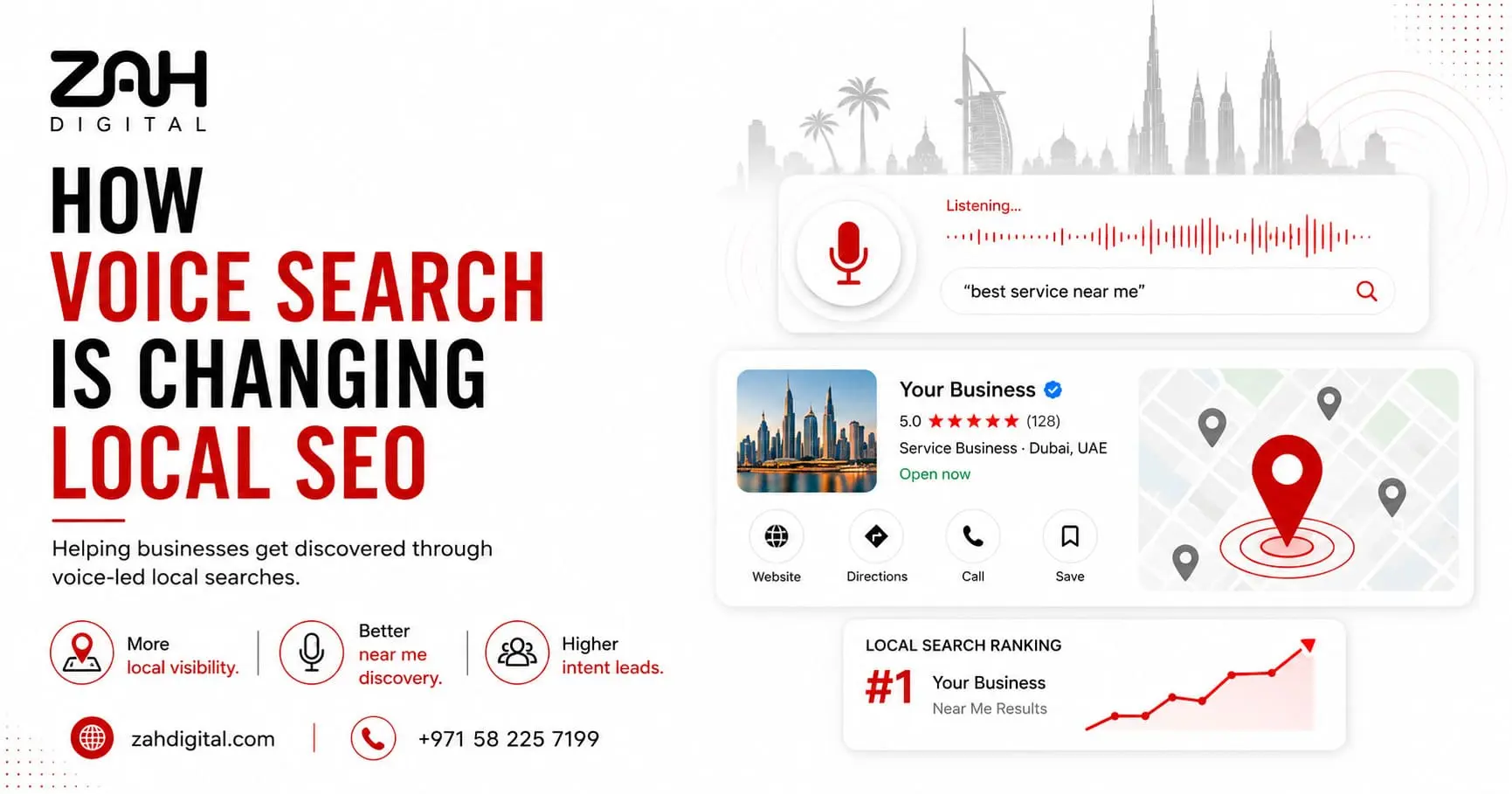
People will no longer need to type “emergency plumber Dubai” or “coffee shop near me” into a search box. But they ask Siri. Alexa. Google Assistant. Or an AI-powered device a complete question. “Where can I find a reliable plumber who’s open right now?”
That small change in behaviour will have a big effect on local search.
Voice assistants will often return one direct recommendation. Rather than a page full of blue links. So businesses that adapt their websites. Listings. Also content for voice search local SEO. This will gain a better chance of becoming the answer customers hear first.
What Is Voice Search and Why Is It Growing?
Voice search will allow people to find information. By speaking to a smartphone. Smart speaker. Vehicle system. Or wearable device. Users will rely on it. Because speaking feels faster. Also more convenient. Especially while driving and cooking. Or multitasking.
Recent industry estimates will suggest that about 20.5% of people worldwide will use voice search. While mobile devices will remain the main access points. But exact usage levels will vary by country. Device and survey method.
Moreover, voice technology now works alongside generative AI. Modern assistants can understand follow-up questions, location context and conversational wording. Consequently, voice search has moved beyond simple weather updates and music requests. Get details on SEO Service in Dubai.
How Voice Search Queries Differ From Text Search
People type short phrases. But speak in complete sentences.
For example, a typed query might read “dentist Abu Dhabi.” A spoken query will sound more like, “Which dentist near me offers emergency appointments tonight?”
Search behaviour | Text search | Voice search |
Typical wording | Short keywords | Natural questions |
Query length | Usually brief | Longer and more specific |
Common intent | Research or comparison | Immediate answer or action |
Location language | City or area name | “Near me,” “closest” or “open now” |
Expected result | Multiple listings | One concise recommendation |
So conversational search queries and long-tail keywords will matter more than isolated phrases. Businesses must create content. That reflects how real customers speak. This includes questions beginning with who. What. Where. When. Why and how.
How Voice Search Affects Local SEO Rankings
Voice assistants will depend heavily on accurate and trustworthy local information. Therefore, a complete business profile can influence whether an assistant recommends a company.
Google explains that local results depend mainly on relevance, distance and prominence. Reviews, complete business information and accurate opening hours can support stronger local visibility.
For that reason, Google Business Profile optimization should include:
- The correct business category
- An accurate address and service area
- Current opening hours
- Local phone details
- Updated photographs and services
- Regular, genuine customer reviews
Meanwhile, near me searches depend partly on the searcher’s location. A business cannot control distance, but it can improve relevance and prominence through accurate listings, locally focused pages and a strong reputation. Looking for a AEO Optimization Agency in Dubai?
Key Strategies for Voice Search Local SEO
Effective voice search local SEO starts with answering specific questions clearly. Each important service page must explain what the service includes. Who it helps. Where it is available and how customers will take action.
Businesses must focus on these areas:
Build Question-Based Content
Use FAQs and natural headings that mirror spoken questions. For instance, “How much does air-conditioning repair cost in Dubai?” matches voice behaviour better than a vague heading such as “AC Prices.”
Improve Mobile Performance
Many spoken searches happen on smartphones. Therefore, pages should load quickly, display correctly on small screens and provide visible call or direction buttons.
Maintain NAP Consistency
The business name. Address and phone number must remain consistent. Across the website. Business directories. Also social profiles. Conflicting information may reduce trust.
Add Structured Data
LocalBusiness structured data can help Google understand details such as business hours, departments and location information. However, schema supports interpretation rather than guaranteeing a particular ranking or rich result. Get details on CRO & Funnel Optimization Service in Dubai.
Voice Search and Zero-Click Results
A zero-click search will give the user an answer directly on the results page. Or through a voice assistant. The searcher will hear opening hours. Directions. A phone number. Or a short service explanation. Without visiting the business website.
This does not make website traffic unimportant. Instead, it changes the goal of local SEO optimization. Businesses must structure information so search platforms can understand, quote and trust it.
Clear summaries, concise FAQs, descriptive headings and locally relevant information also support Answer Engine Optimization and Generative Engine Optimization. Therefore, the same improvements can strengthen visibility across traditional search, AI Overviews and conversational assistants.
Related Services:
» Social Media Marketing Service in Dubai
» Website Designing Service in Dubai
» Performance Marketing Agency in Dubai
The Future of Voice Search and Local SEO
Voice search will become conversational. As assistants will improve their ability to understand context. A user will ask for a nearby restaurant. Narrow the request to family-friendly options. Then request directions. Without repeating the location.
Businesses must prepare for connected and multi-step searches. Rather than targeting one keyword at a time. Strong local authority. Detailed service information. Also accurate business data will remain essential.
Companies that invest in Google Business Profile optimization and helpful content. Also technical clarity will have a stronger chance of appearing wherever customers search next.
Related Articles:
» SEO Content Strategy for Lead Generation in Dubai Market
» What is Search Intent and Why It Matters for SEO?
» Best SEO Strategy for Multi-Location Businesses
» SEO Mistakes Dubai Businesses Must Avoid
» AEO vs SEO: What Is the Difference?
Make Your Business Easier to Find—and Easier to Recommend
Voice search rewards businesses. That provides clear answers at the right moment. By improving your listings. Website speed. Location pages. FAQs and structured data. You will turn spoken searches into calls. Bookings and store visits.
Start refining your voice search local SEO strategy today. So customers do not simply find your competitors first. They will hear your business recommended.
FAQs: How Voice Search Is Changing Local SEO
Around 20.5% of the global population will reportedly use voice search. Although percentages will vary by market. Age group. Device and research method. Mobile phones. Smart speakers. Also vehicle assistants will contribute to adoption. Businesses must focus on customer search behaviour. Rather than relying on one global statistic.
Yes. Voice search will continue to develop as smartphones. Smart speakers. Connected vehicles. Also generative AI assistants will become capable. Growth will involve better conversational understanding. Follow-up questions. Also personalised responses. Not merely an increase in traditional voice commands.
“Near me” searches. This will help users find businesses close to their current location. Search platforms will compare distance with relevance. Also prominence. So businesses must maintain accurate addresses. Categories. Hours. Services and reviews. To improve their eligibility for local recommendations.
Google identifies relevance. Distance and prominence. As the primary local ranking considerations. Relevance will measure how closely a listing matches the query. Distance considers the searcher’s location. Also prominence will reflect how established or well-known the business appears.
Schema markup can help search engines understand business details and page content more accurately. LocalBusiness structured data may describe locations, hours and departments. However, adding schema does not guarantee a voice result, featured snippet or higher organic ranking.
Mobile optimization will matter. Because many voice searches begin on smartphones. A fast and responsive page will make it easier. For users to call. Request directions. Complete a form. Or book a service. After receiving a spoken or mobile search result.
A Google Business Profile supplies information. That assistants will use for local recommendations. This includes the business category. Address. Phone number. Opening hours. Reviews and services. Keeping these details complete. Also current strengthens local relevance. It gives users more reliable answers.
Conversational keywords are phrases written in the way people naturally speak. Examples include “Where can I repair my phone near me?” and “Which accountant is open on Saturday?” They tend to be longer, more specific and more question-based than traditional search keywords.
Voice search can work through smartphones. Smart speakers. Tablets. Smart displays. Connected vehicles. Televisions and wearable devices. Common voice assistants will include Siri. Alexa and Google Assistant. While newer AI assistants will increasingly support natural dialogue. Also follow-up requests.
Voice SEO pricing will depend on the number of locations. Website condition. Competition and required services. A small business will only need profile. Also content improvements. While a multi-location company will require technical SEO. Schema implementation. Citation management and ongoing reporting.
Businesses may notice early improvements within three to six months, although highly competitive markets often require longer. Results depend on the website’s authority, profile quality, location competition, review activity, technical condition and consistency of ongoing optimization.
Traditional SEO will often target typed keywords. Also ranked web results. While voice SEO will focus more heavily on spoken questions. Local intent. Concise answers and conversational language. The two approaches will overlap. So businesses must integrate voice optimization into a broader SEO strategy. Rather than treat it separately.