

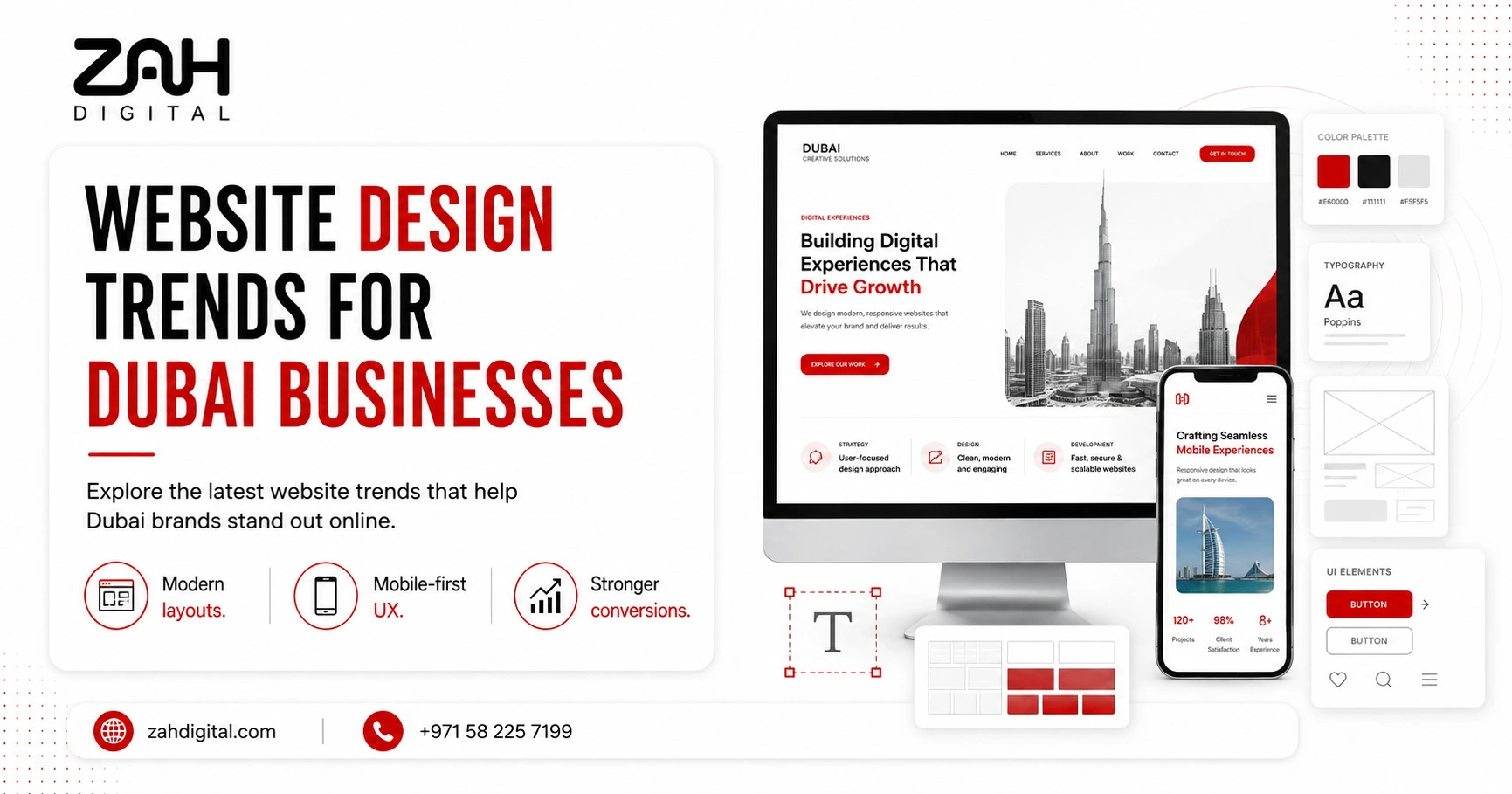
Dubai customers will rarely judge a website on appearance alone. They expect it to load quickly. Work smoothly on mobile. Communicating clearly in more than one language. Also guide them towards an action without wasting time.
So the leading website design trends in Dubai for 2026. This will focus less on decorative effects. Also more on intelligent and practical experiences that support business growth.
1. AI-Powered Personalisation Becomes More Useful
Artificial intelligence is moving beyond basic chatbots. In 2026. Businesses can use AI to adjust website content. According to a visitor’s location. Browsing behaviour. Preferred language. Or previous interactions.
A Dubai property website can show investment opportunities to an overseas visitor. While presenting rental listings to a local resident. Likewise an e-commerce store may recommend products based on browsing history. Weather conditions or seasonal demand.
But personalisation must remain subtle. Customers want relevant information. Not a website that feels intrusive. A skilled web design company in Dubai will balance automation with privacy. Speed and human control. Get details on Website Designing Service in Dubai.
2. Arabic-English UX Moves Beyond Simple Translation
Dubai businesses will serve Emiratis. Expatriates. Tourists and international investors. So adding an Arabic button to an English website will no longer be enough.
Modern bilingual websites will need separate design consideration. For left-to-right and right-to-left reading. Navigation. Icons. Forms. Text alignment and visual hierarchy must work naturally in both languages.
Official UAE digital-service guidance will also emphasize clear separation between Arabic and English content. While Dubai and federal platforms will increasingly prioritise accessible bilingual experiences.
Businesses must avoid direct word-for-word translation. Arabic headlines will require different spacing. Wording and typography to carry the same meaning effectively. This is becoming an important part of UAE website design in 2026.
3. Mobile-First Commerce Leads the Design Process
A desktop design that shrinks to fit a phone no longer counts as mobile-friendly. Instead, mobile-first design in Dubai starts with the smallest screen and builds upwards.
Menus should remain easy to tap. Forms should request only essential information. Product filters must work without endless scrolling, while payment options should appear clearly at checkout.
This matters. Because the UAE continues to experience strong internet adoption. Also rapid growth in mobile connection speeds. Customers expect fast and app-like experiences. Even when they visit a standard business website.
For e-commerce website design in the UAE. Features such as guest checkout. Saved carts. WhatsApp enquiries. Multilingual product information. Also local payment integration will directly influence conversions.
4. Speed Becomes Part of the Visual Design
Large videos, oversized animation files and complicated scripts can make a website look impressive in a presentation. But they often slow down the real customer experience.
In 2026. Designers will treat performance as part of the creative process. Images will load only when needed, motion effects will remain lightweight, and developers will reduce unnecessary code.
Google’s Core Web Vitals will continue to assess loading performance. Responsiveness and visual stability. Interaction to Next Paint. Measures how quickly a page responds after a visitor clicks. Taps or types.
Therefore, effective responsive website design in Dubai must feel quick, not merely look polished. Looking for a Social Media Marketing Service in Dubai?
5. Minimalism Gains a More Local Character
Minimal design will remain popular, although the generic white-background template is losing its appeal. Dubai businesses increasingly want clean layouts with recognisable local character.
That will include warm desert-inspired colours. Geometric patterns. Refined Arabic typography. Or photography that reflects real communities. Also workplaces in the UAE. Whereas generous spacing and strong visual hierarchy will help users scan information faster.
The goal isn’t to fill every section with cultural symbols. Instead, the design should feel relevant to Dubai without becoming predictable or overly decorative.
6. Accessibility Becomes a Business Standard
Accessible design will help people with visual and hearing. Cognitive. Or motor difficulties will use a website more easily. It will create a better experience for older users. Mobile visitors. Also people reading content in a second language.
Dubai and UAE digital platforms will increasingly align with recognised Web Content Accessibility Guidelines. This includes WCAG 2.1 and 2.2 Level AA.
So stronger colour contrast. Keyboard navigation. Readable fonts. Descriptive image text. Also properly labelled forms will become standard parts of professional UX/UI design trends.
Related Services:
» AEO Optimization Agency in Dubai
» CRO & Funnel Optimization Service in Dubai
2024 vs 2026 Website Design Priorities
Design Priority | Typical 2024 Approach | Stronger 2026 Approach | Business Benefit |
Personalisation | General content for everyone | AI-assisted visitor journeys | More relevant enquiries |
Bilingual design | Translated pages | Dedicated Arabic-English UX | Better local engagement |
Mobile experience | Responsive resizing | Mobile-first conversion paths | Easier browsing and checkout |
Performance | Speed improved after launch | Speed planned during design | Lower abandonment |
Accessibility | Optional enhancements | Built into the design system | Wider audience reach |
Animation | Decorative effects | Lightweight, purposeful motion | Better product storytelling |
Related Articles:
» Technical SEO Basics for Business Websites
» How to Build an SEO Strategy Before Launching a Website?
» How to Make Your Website Answer-Engine Friendly?
» Website Design Checklist for Small Businesses
» How Long Does SEO Take to Show Results?
Build a Website That Matches Dubai’s Expectations
The strongest websites in 2026 won’t follow every trend. Instead, they’ll select the right features for their customers, services and sales process.
ZAH DIGITAL will combine strategy. Visual design. Responsive development. Also conversion-focused UX to create websites built for the UAE market. As an experienced website design agency in Dubai. We help businesses develop fast and bilingual. Also future-ready digital experiences that support measurable growth.
FAQs: Website Design Trends for Dubai Businesses
Key trends will include AI personalisation. Bilingual Arabic-English UX. Mobile-first commerce. Faster performance. Accessible layouts and lightweight interactive design. Businesses are choosing practical improvements. That makes websites easier to use and more likely to convert.
Many customers research services, compare products and contact companies through smartphones. Therefore, mobile-first design helps visitors browse, enquire and purchase without struggling with small buttons or complicated menus.
Arabic content will help businesses reach Emirati customers. Government-related audiences. Also Arabic-speaking residents. But the Arabic version must receive its own layout. Typography and right-to-left usability testing.
AI can recommend relevant products. Personalise content. Answer common questions. Also qualify enquiries. Businesses should use it carefully. Avoid collecting unnecessary customer information.
Yes. Although customers will expect more than automated greetings. A useful chatbot should answer specific questions, collect relevant enquiry details and provide a simple route to a human team member.
Responsive design will automatically adjust a website to suit mobile phones. Tablets. Laptops and large screens. It will keep text readable. Images properly sized. Also navigation easy to use.
A website must show its main content quickly. Also respond promptly when users interact with it. Heavy videos, uncompressed images and unnecessary scripts should not delay important information.
3D design will grow in property, hospitality, automotive, architecture and luxury retail websites. But designers must use it selectively. So that it supports the buying journey. Without slowing down the page.
Accessible design will include readable text. Sufficient colour contrast. Keyboard controls. Captions. Descriptive image text. Also clearly labelled forms. These features will make the website easier for a wider range of users.
Yes, but minimalism now includes stronger brand character and local relevance. Dubai businesses are combining clean layouts with distinctive typography, photography and carefully selected regional design influences.
Most companies must review their website every year. Also consider a major redesign. Every three to five years. A redesign will be needed sooner. When the website becomes slow. Outdated or difficult to manage.
Review the agency’s portfolio. Development process. Mobile performance. Also understanding of the UAE market. Ask whether it provides SEO structure. Bilingual design. Accessibility testing and post-launch support.