

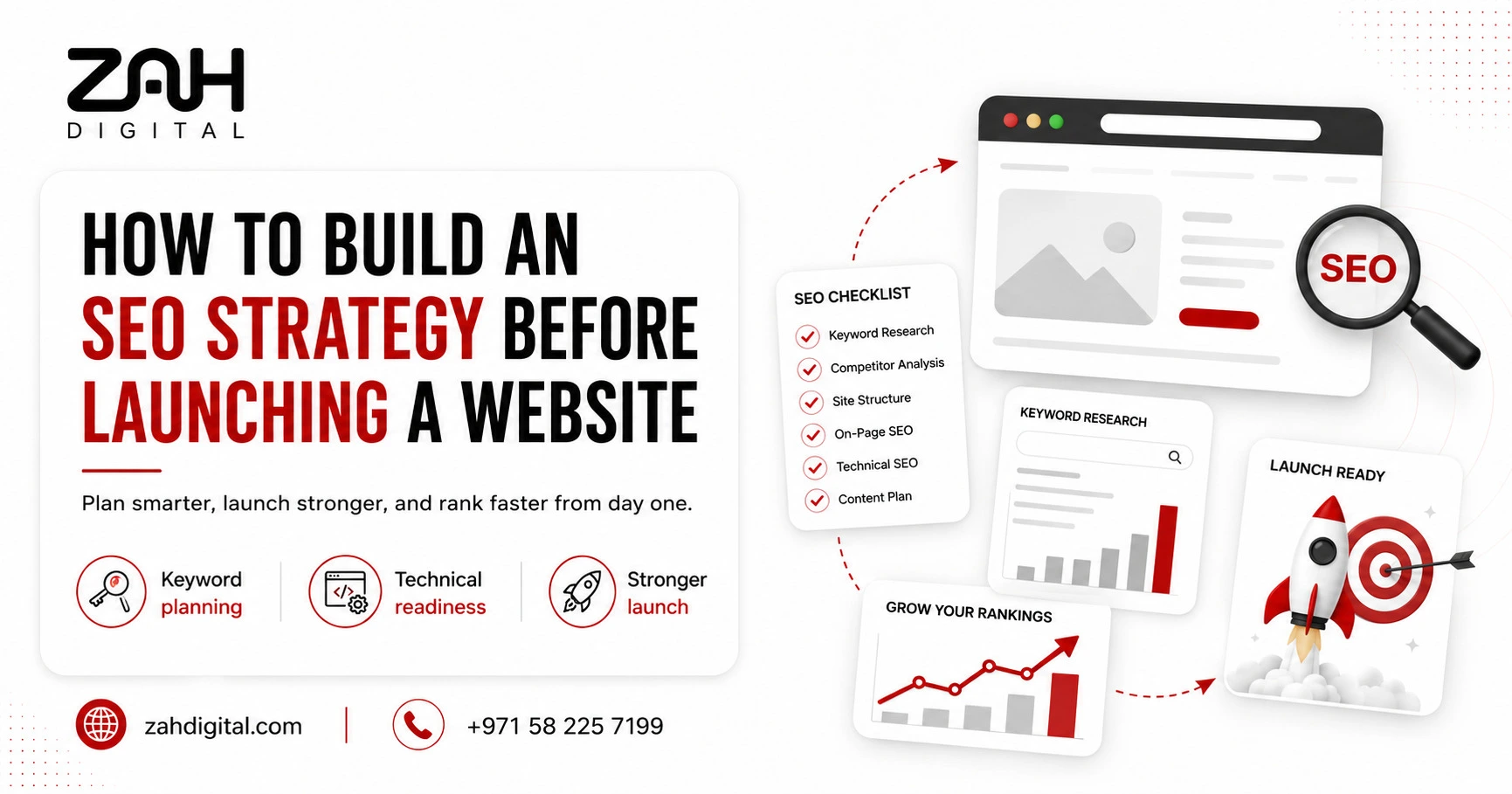
A beautiful website can still launch to silence. Pages can look polished. Yet poor keyword targeting. Confusing navigation and technical errors. This will prevent search engines from understanding them. Fixing these problems after launch. This will often mean rewriting content. Changing URLs and paying developers twice.
A structured pre-launch SEO strategy avoids that disruption. It connects search demand. Website development and content creation. From the beginning. So your new site launches with a clearer purpose. Stronger foundations. Also a better chance of attracting qualified visitors.
Why Pre-Launch SEO Strategy Matters
SEO should influence the website plan rather than become a final checklist item. When businesses delay SEO planning, designers may create pages without search demand, while developers may build navigation that limits organic growth.
Early planning helps you:
- Identify commercially valuable search terms
- Create pages around genuine customer needs
- Build crawlable navigation and internal links
- Reduce expensive post-launch changes
- Measure performance from the first day
Consequently, your marketing, content and development teams work towards the same business goals. Get details on Local SEO Service in Dubai.
Start Keyword Research Before Website Development
A practical keyword research strategy begins with your services, locations, audience questions and buying stages. However, search volume alone should not decide which pages you create.
Each keyword must match a clear intent:
- Informational: Users want guidance or answers
- Commercial: Users compare services or providers
- Transactional: Users are ready to enquire or buy
- Local: Users need a nearby or location-specific service
For instance, “what is technical SEO?” suits an educational article. Meanwhile, “technical SEO agency in Dubai” deserves a focused service or location page.
Keyword mapping also prevents several pages from targeting the same phrase. Therefore, assign one primary topic and a supporting keyword group to every planned URL.
Analyse Competitors Before Finalising the Sitemap
Competitor analysis will reveal what already performs in your market. Review the websites ranking for your priority searches. Not only the companies you consider direct business rivals.
Assess their page types. Content depth. Title tags. Internal links. Featured snippets and backlink profiles. Identify subjects they explain poorly. Or ignore completely. These gaps may give your website a stronger angle.
The goal will be not to copy another site. But use the research to create clearer. Also more useful and better-structured pages.
Plan Website Architecture and URL Structure
A logical architecture will help visitors find information quickly. Likewise it allows search engines to understand relationships between your pages.
Keep important pages within a few clicks of the homepage. Group related content beneath relevant service. Or category hubs. Also use short, descriptive URLs like:
example.com/seo-services/technical-seo/
Avoid unnecessary dates. Random numbers and lengthy folder structures. Finalise URLs before launch whenever possible. Because changing them later will require redirects. This may temporarily affect rankings. Looking for a SEO Service in Dubai?
Build On-Page SEO Foundations
Your website SEO checklist must define the on-page requirements. For every indexable page.
Essential On-Page Elements
- One clear primary keyword and search intent
- A unique title tag and meta description
- One descriptive H1 heading
- Logical H2 and H3 subheadings
- Helpful internal links with natural anchor text
- Descriptive image file names and alt text
- A strong next step, enquiry form or call to action
However, avoid forcing exact-match keywords into every paragraph. Natural language. Topical coverage. Also useful answers will matter more than repetition.
Complete a Technical SEO Checklist Before Launch
Strong content cannot compensate for a website. That search engines struggle to crawl or render. But complete a thorough technical SEO review. Before publishing.
Check that the site has:
- HTTPS security
- Clean canonical tags
- A valid XML sitemap
- A correctly configured robots.txt file
- Working redirects
- No accidental noindex tags
- Custom 404 pages
- Structured data where relevant
- Fast-loading, compressed images
- No broken internal links
- Consistent desktop and mobile content
Additionally, test staging settings carefully. A common launch mistake occurs when developers carry password protection or search-blocking directives into the live website.
Pre-Launch vs Post-Launch SEO Priorities
| SEO Element | Before Website Launch | After Website Launch |
| Keyword mapping | Assign one core intent to each page | Refine targets using query data |
| URL planning | Finalise short, descriptive URLs | Avoid changes unless necessary |
| Technical testing | Check crawling, indexing and mobile usability | Monitor errors and performance |
| Content | Publish essential service and trust pages | Expand clusters using search demand |
| Internal linking | Connect core pages and topic hubs | Add links from new content |
| Performance target | Aim for fast, stable mobile pages | Improve using real-user data |
| Analytics | Configure tracking and conversions | Review leads, engagement and rankings |
Create Content Strategy and Topic Clusters
Do not launch with disconnected pages covering unrelated subjects. Instead, create a content strategy based on topic clusters.
A central service page can act as the pillar. While supporting articles will answer narrower questions. An SEO services pillar can connect to pages about keyword research. Local SEO. Technical audits and content optimisation.
This structure demonstrates topical depth. At the same time. It will give users several relevant paths through the website. Get details on AEO Optimization Agency in Dubai.
Prioritise Mobile-First Performance and Core Web Vitals
Google will evaluate websites from a mobile-first perspective. Responsive design must influence layouts. Navigation. Forms. Also content presentation from the earliest development stage.
Test pages on real devices. Not only desktop browser simulators. Buttons must be easy to tap. Text should remain readable. Also pop-ups must not block the main content.
For Core Web Vitals. Aim for:
- Interaction to Next Paint: 200 milliseconds or less
- Largest Contentful Paint: 2.5 seconds. Or less
- Cumulative Layout Shift: 0.1 or less
These benchmarks will support faster. Also more stable visitor experience.
Prepare Local SEO Before Going Live
Businesses serving specific locations should include local SEO in their SEO before website launch plan. Create accurate contact details, location-focused pages and locally relevant service information.
Additionally, prepare or optimise your Google Business Profile, use consistent business information across directories and add LocalBusiness schema where appropriate. However, avoid creating thin pages that simply replace one city name with another.
Related Services:
» Website Designing Service in Dubai
» Social Media Marketing Service in Dubai
» CRO & Funnel Optimization Service in Dubai
» Performance Marketing Agency in Dubai
Configure Tracking and Analytics
Set up Google Analytics. Google Search Console. Also conversion tracking. Before launch. You may lose valuable information from your first visitors.
Track meaningful actions like calls. Form submissions. Quotation requests. Purchases and appointment bookings. Document benchmark rankings. Also complete a final crawl immediately. After the site goes live.
Launch with a Search Strategy, Not Just a Website
A successful website launch will require more than attractive design. It needs keyword intelligence, deliberate architecture, technically sound development and content shaped around real customer searches.
ZAH DIGITAL will help businesses connect SEO strategy with design. Development and measurable lead generation. With professional pre-launch SEO support. Your website can enter the market prepared. To earn visibility. Rather than spending months correcting preventable mistakes.
FAQs: How to Build an SEO Strategy Before Launching a Website
A pre-launch SEO strategy. This is a structured plan for optimising a website. Before it becomes publicly available. It will cover keyword research. Page mapping. Website architecture. Content. Technical settings. Internal links and analytics. Its purpose is to help search engines crawl. Understand and index the website correctly from launch.
Doing SEO before launch. This will prevent costly structural and content changes later. It will help you create pages around real search demand. Establish crawlable navigation. Also avoid technical indexing problems. As a result, the live website starts with stronger relevance, usability and measurement systems.
SEO planning must begin before wireframes. Page layouts and website copy will receive final approval. Keyword research and competitor analysis must shape the sitemap first. Developers. Designers and writers will then build each page around an agreed audience. Search intent and conversion goal.
Start with your services. Products. Audience problems and target locations. Then evaluate search intent, relevance, competition and commercial value. Group closely related terms and assign them to one suitable page. Avoid choosing keywords. Based only on high search volume. Because traffic without the right intent will rarely convert.
A website SEO checklist must cover page titles. Headings. Meta descriptions. Internal links. Image optimisation. Mobile usability. Page speed. HTTPS. Canonical tags. Structured data. XML sitemaps and robots.txt settings. It must also include analytics and conversion tracking. Also a final crawl before publication.
A small service website may need two to four weeks of SEO planning and implementation. Larger websites. Ecommerce stores. Or multilingual platforms will require several months. The timeline will depend on page count. Competition. Technical complexity. Content requirements. Also how early the SEO team joins the project.
The cost will vary according to website size. Market competition and required services. A basic project will include keyword mapping and technical checks. While a complete strategy will cover architecture. Content briefs. Schema. Analytics and launch support. A detailed audit will usually provide the most accurate quotation.
Yes. You can optimise a website after launch. But the process will involve restructuring navigation. Rewriting pages. Changing URLs and correcting development issues. Planning SEO before website launch will generally save time. It also reduces the risk of indexing problems. Duplicate content. Or missed keyword opportunities.
Accidental noindex tags. Blocked robots.txt rules. Missing internal links. Broken canonicals and server errors will delay indexing. Search engines will also struggle with slow pages. JavaScript rendering problems. Or poor sitemap configuration. Run a technical crawl before. Also immediately after launch.
Topic clusters will help new websites organise content. Around clear areas of expertise. A main pillar page will target a broad service. While supporting pages answer specific questions. Users can explore related information easily. Also search engines can understand the website’s topical relationships more clearly.
Yes. Verify the domain in Google Search Console. Submit the XML sitemap. Also inspect important URLs after launch. But submission will not guarantee immediate ranking. Google will still need to crawl. Evaluate and index the pages. Based on technical accessibility. Relevance. Quality and internal linking.
ZAH DIGITAL will develop the keyword strategy. Competitor analysis. Sitemap. URL plan. Content briefs. On-page requirements and technical launch checklist. The team will also configure analytics. Also monitor indexing after publication. Giving your website a coordinated SEO foundation. From planning through go-live.