
Search behaviour has changed quickly. People will still use Google. But they also ask ChatGPT. Gemini. Perplexity. Also voice assistants for direct recommendations. So websites must do more than rank for keywords. They need to organise information. So search engines and AI platforms can understand. Extract. Also confidently present the right answer.
A strong website structure for AEO. This will give every topic a clear place. Also connect related information. Removes unnecessary complexity. It will also support SEO. Usability and conversions. Making it a practical investment. Rather than another passing marketing trend.
What Is AEO, and How Is It Different from SEO?
AEO (Answer Engine Optimization) will help digital platforms identify concise and trustworthy answers. Within your website. Traditional SEO will often focus on rankings. Backlinks and keyword relevance. AEO will pay greater attention to questions. Entities. Context and answer clarity.
SEO may help a service page appear on page one. AEO helps a specific paragraph from that page appear in featured snippets, AI-generated summaries or spoken search results. Therefore, both approaches work best together.
Traditional SEO vs AEO Website Structure
Area | Traditional SEO Structure | AEO-Focused Structure |
Main objective | Rank pages for target keywords | Provide extractable answers |
Page organisation | Keyword-led categories | Intent-led topic clusters |
Content format | Long descriptive sections | Direct answers followed by detail |
Technical signals | Titles, links and metadata | Schema, entities and context |
Search opportunity | Standard organic listings | AI answers, snippets and voice results |
User journey | Search, click and browse | Ask, receive and verify |
Why Website Architecture Matters for AI Search
AI systems do not interpret a website exactly as a human visitor does. They analyse relationships between pages, headings, entities, links and structured information. Consequently, a confusing website can weaken otherwise valuable content.
Clear architecture strengthens AI search optimization because it shows which pages cover broad subjects and which pages answer specific questions. For instance, a digital marketing website may use “SEO Services” as a main hub, then connect pages about local SEO, technical audits, content strategy and AEO.
This approach also improves semantic SEO. Instead of publishing disconnected pages around similar keywords, the website builds a complete knowledge network around each service.
A Step-by-Step Framework for an AEO-Friendly Website
1. Build Pages Around Search Intent
Start by identifying what people want to know, compare, solve or purchase. Then assign each intent to one clear page. Avoid creating several weak pages. That competes for the same question.
Service pages must answer what the service is, who needs it, how it works, what it includes and why the business should act. Meanwhile, supporting blog posts can address detailed conversational search queries.
2. Create Topic Hubs and Supporting Clusters
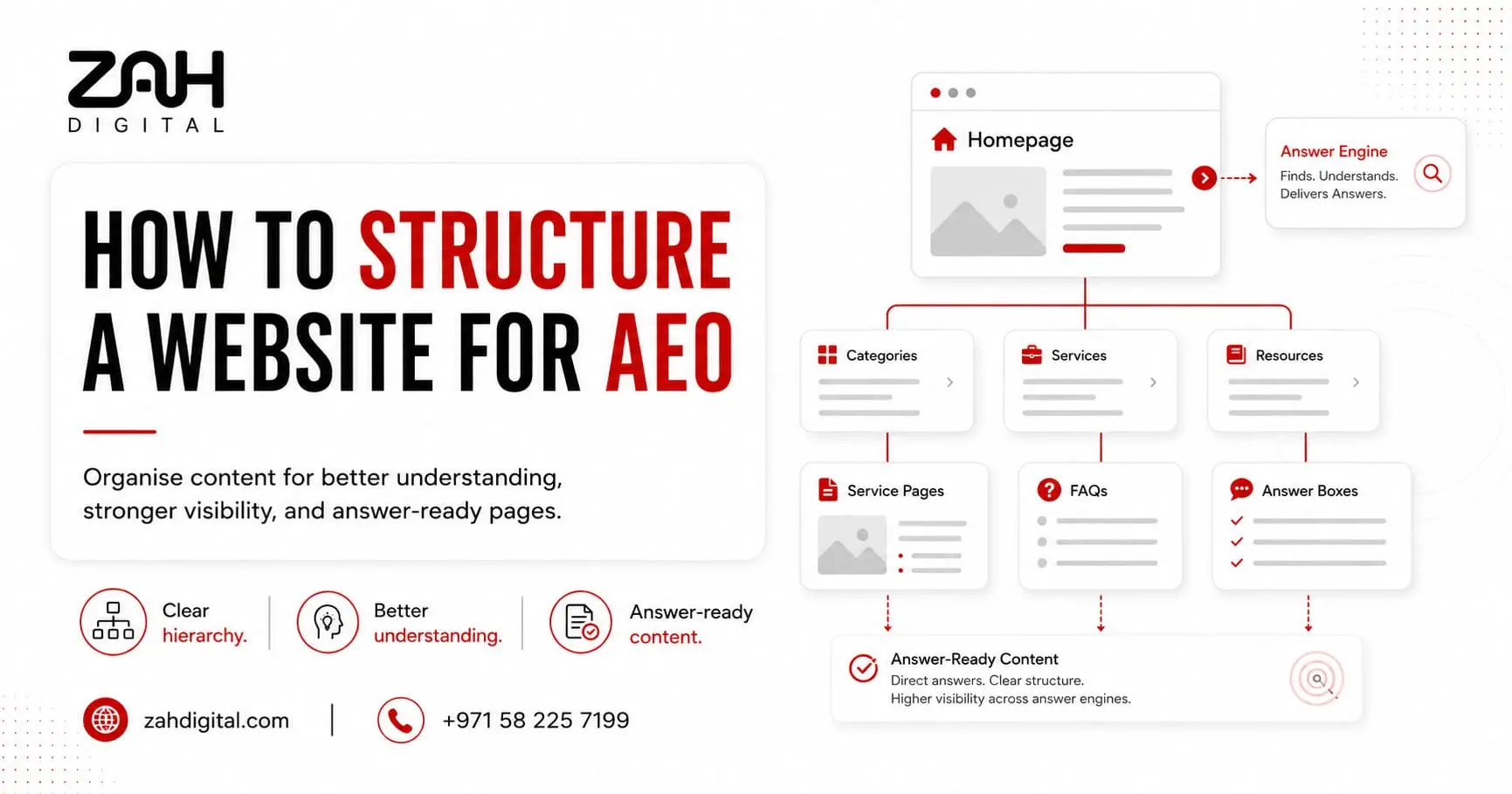
Each core service deserves a central hub page. Supporting articles should explore related questions, use cases, costs, problems and comparisons. In addition, every supporting page should link back to the main hub.
This cluster structure helps search engines understand topical depth. It also supports GEO (Generative Engine Optimization) because generative platforms can find several connected sources that reinforce the same subject.
3. Use a Clear Content Hierarchy
A logical content hierarchy will make every page easier to scan and interpret. Use one H1 for the main subject. H2 headings for key sections. Also H3 headings for supporting details.
Place a direct answer near the beginning of each important section. After that, expand with explanations, steps or examples. This answer-first format serves impatient readers while giving search engines enough context to assess meaning.
4. Strengthen Internal Linking
Internal links should guide users towards genuinely helpful pages. Therefore, use descriptive anchor text such as “AEO services in Dubai” rather than vague wording like “click here.”
Also, connect commercial pages with useful educational content. A blog about voice search, for example, should link to the relevant optimisation service. This creates a natural route from information gathering to enquiry. Looking for a SEO Service in Dubai?
Add Structured Data That Explains Page Meaning
Structured data / schema markup will give machines a standard way to understand content. Depending on the page. Businesses can use Organization. LocalBusiness. Service. Article. BreadcrumbList. Or FAQPage schema.
However, schema cannot rescue thin or misleading content. The visible page and the markup must match. Additionally, businesses should maintain consistent company names, service details, addresses and contact information across the website.
Breadcrumb schema also helps define page relationships. For example. Home > Digital Marketing Services > AEO Services will create a clearer pathway. Than an isolated page with no category context.
Optimise Sections for Featured Snippets and Voice Search
To target featured snippets. Answer specific questions in a compact paragraph. Numbered process or comparison table. Definitions should usually begin with the subject itself, while “how-to” queries benefit from ordered steps.
For voice search optimization, write questions the way customers speak. “How can AEO help my Dubai business?” sounds more natural than “AEO Dubai benefits.” However, conversational writing should remain precise and professional.
Short answers should not replace detailed content. Instead, they should introduce it. A clear answer earns attention, while supporting detail builds trust.
Related Services:
» CRO & Funnel Optimization Service in Dubai
» Social Media Marketing Service in Dubai
» Website Designing Service in Dubai
» Performance Marketing Agency in Dubai
Common AEO Structure Mistakes
Many businesses publish large blocks of text without meaningful headings. Others create duplicate pages for minor keyword variations or hide valuable answers behind vague introductions. As a result, search engines struggle to identify the most useful passage.
Another common mistake involves orphan pages with no internal links. Inconsistent service names, outdated schema and poorly organised FAQs can also weaken understanding.
Most importantly, businesses often optimise isolated pages instead of the complete website. Effective AEO requires consistent architecture across services, blogs, location pages and conversion paths.
Related Articles:
» AEO vs SEO: What Is the Difference?
» What is AEO and Why Should Dubai Businesses Care?
» How to Build an SEO Strategy Before Launching a Website?
» How to Make Your Website Answer-Engine Friendly?
» How Long Does SEO Take to Show Results?
How ZAH DIGITAL Builds Websites for Answer Engines
ZAH DIGITAL combines technical SEO, content planning, schema implementation and GEO (Generative Engine Optimization) to create websites that both people and machines can understand.
We review your current architecture, map customer questions, develop topic clusters and improve on-page answers. In addition, our team strengthens internal linking, schema coverage and content clarity without making pages sound mechanical.
Your website should not simply exist in search results. It should become a trusted source that answer engines can quote, summarise and recommend.
Speak with ZAH DIGITAL today. To build an AEO-ready website. That supports Google rankings. AI visibility. Voice search and qualified enquiries.
FAQs: How to Structure a Website for AEO
The best website structure for AEO uses clear service hubs, supporting topic clusters, logical headings and descriptive internal links. Each page should answer one main search intent without competing with another page.
No. AEO (Answer Engine Optimization) strengthens traditional SEO by making content easier for answer engines to extract. Businesses will still need technical SEO. Authority. Relevance. Also a strong user experience.
Website structure will help AI systems understand services and questions. Also supporting topics relate to one another. Clear relationships will improve the chance of content appearing in AI summaries and recommendations.
Useful schema types will include Organization. LocalBusiness. Service. Article. BreadcrumbList and FAQPage. The right choice will depend on the page type. Also the information shown to visitors.
Use one H1 for the page topic. H2 headings for major questions. Also H3 headings for supporting details. Each heading must clearly describe the answer found below it.
Yes. Internal links will reveal relationships between topics. Also guide search engines towards your most important pages. Descriptive anchors will also provide context about the destination page.
Definitions. Short paragraphs. Numbered steps. Bullet points. Also comparison tables will often work well for featured snippets. The answer must appear directly beneath a relevant question-based heading.
Use natural questions. Simple sentence structures. Also concise answers. Voice search optimization. This will also benefit from accurate local information. Also mobile-friendly pages.
A topic cluster will include one central page. Also several supporting pages around related questions. Internal links will connect the cluster. Also strengthen the website’s authority on that subject.
Semantic SEO will help search engines understand meaning. Entities and topic relationships. Rather than matching exact keywords alone. AEO uses these signals to make answers clearer. Also easier to retrieve.
AEO focuses on direct answers across search and voice platforms. GEO (Generative Engine Optimization) focuses more specifically on visibility inside generative AI responses, citations and summaries.
ZAH DIGITAL can audit your architecture, reorganise service pages, develop topic clusters and implement appropriate schema. We also optimise answers for AI platforms, snippets, voice queries and organic search.