
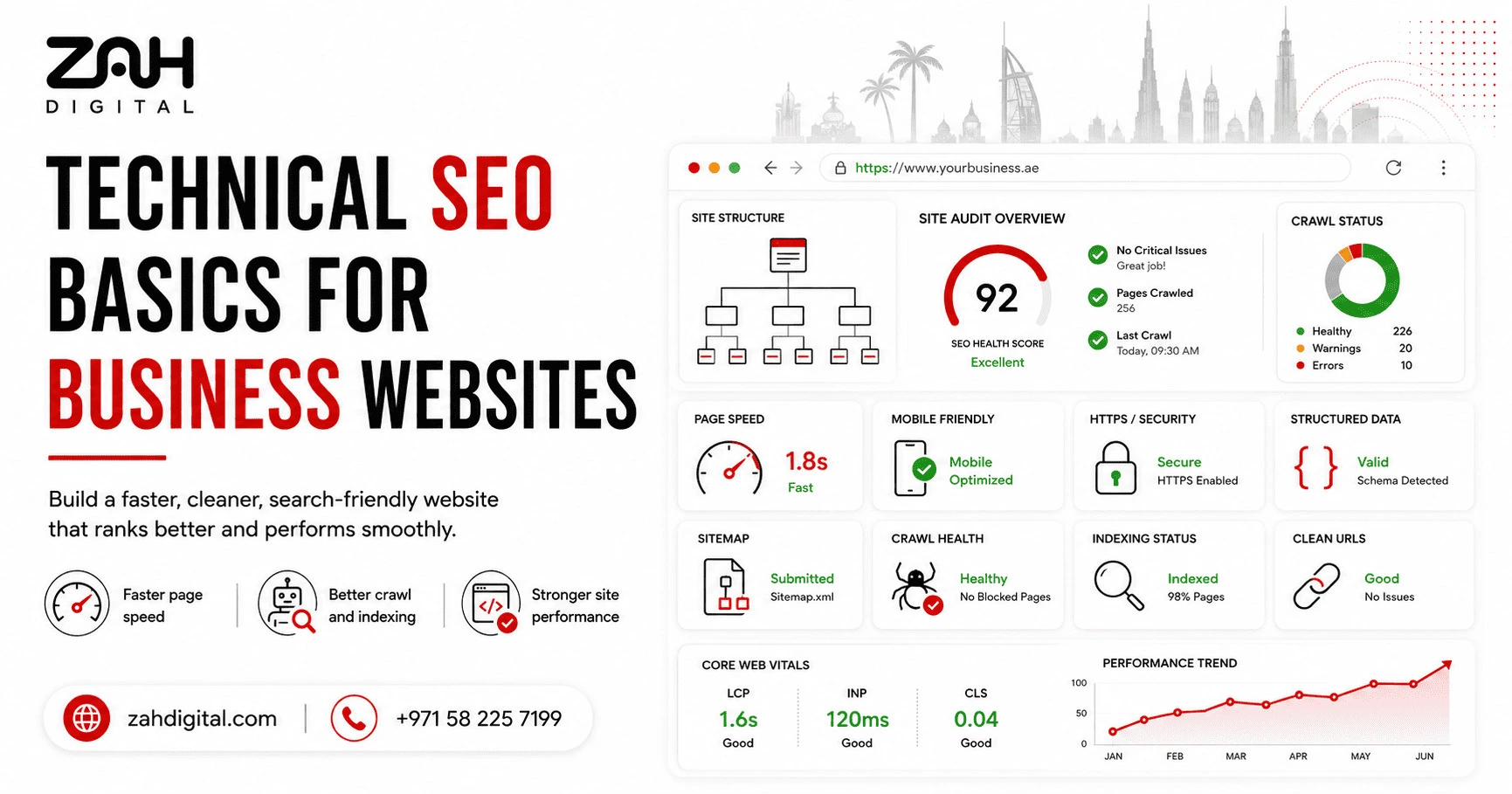
A website will look impressive. Still struggle to rank. Search engines will need to access. Understand and index your pages. Before customers can find them. That is where technical SEO will become essential.
Technical SEO basics will improve the behind-the-scenes structure of a website. This will include speed. Mobile usability. Security. Crawling and indexing. When these elements work correctly. Search engines will process your content more efficiently. So your pages gain a stronger chance of appearing for relevant searches.
For business owners. Good business website SEO will be not only about adding keywords. It will mean removing technical barriers. That quietly reduces traffic. Also leads and conversions.
What Is Technical SEO and Why It Matters for Business Websites
Technical SEO is the process of improving a website’s infrastructure so search engines can crawl, render, index and rank its pages correctly.
Content may attract attention, but technical performance supports visibility. A valuable service page will not generate leads. When Google cannot index it.
A technically healthy website will usually deliver a better customer experience. Pages will load faster. Links work properly. Also visitors will browse without frustrating interruptions. Due to this, technical improvements will often support rankings and conversions. Get details on SEO Service in Dubai.
Website Crawlability and Indexing Basics
Website crawlability will describe how easily search engine bots will discover. Also navigate your pages. Indexing will happen when a search engine stores an eligible page in its database.
Broken internal links. Blocked URLs. Also poor navigation will prevent important pages from being discovered. But a logical site structure will help bots move from your homepage to service. Location and contact pages. Without confusion.
Businesses must regularly check for:
- Broken internal links
- Blocked or inaccessible pages
- Orphan pages with no internal links
- Incorrect noindex tags
- Redirect loops and long redirect chains
- Search Console indexing errors
Site Speed and Core Web Vitals
Site speed optimization reduces the time users wait for pages to load and become interactive. Slow websites will often lose visitors. Before the main content appears.
Google’s Core Web Vitals will assess key parts of the user experience. This includes loading performance. Visual stability and interaction responsiveness. So businesses must compress oversized images. Remove unnecessary scripts. Also improve server response times.
Faster pages will help users move through service information. Also enquiry forms with less friction. Looking for a AEO Optimization Agency in Dubai?
Mobile-Friendliness and Responsive Design
Mobile-friendliness will mean a website works clearly. Also efficiently across smartphones. Tablets and desktops.
Responsive design will adjust page layouts to different screen sizes. But simply shrinking a desktop page will not be enough. Buttons must remain easy to tap, text must stay readable and forms should work without constant zooming.
Since many customers search while travelling, shopping or comparing providers, strong mobile performance directly supports local enquiries and calls.
XML Sitemaps and Robots.txt Configuration
An XML sitemap will give search engines a structured list of important website URLs. It will help crawlers discover new. Updated or deeply placed pages.
A robots.txt file will give crawlers instructions. About which website areas they should or should not access. But one incorrect rule will block an entire service section.
For best results. Businesses must include only valid and indexable URLs in the sitemap. Also review robots.txt rules after redesigns. Migrations. Or major development work.
Structured Data and Schema Markup
Structured data/schema markup will provide search engines. With additional context about page content. It can identify a business. Service. Product. Review. Event or FAQ.
Schema does not guarantee enhanced search results. Nevertheless, accurate markup can help search platforms interpret content more confidently.
Local businesses may benefit from organisation, local business, service, breadcrumb and FAQ schema. In addition, all marked-up information should match the visible page content. Get details on CRO & Funnel Optimization Service in Dubai.
HTTPS, Canonical Tags and Fixing Duplicate Content
HTTPS security protects information transferred between a visitor’s browser and the website. It will reassure customers. When they submit forms. Create accounts. Or make payments.
Canonical tags will tell search engines. Which version of a similar or duplicated page must act as the preferred URL. This matters when filters, tracking parameters or multiple page paths create near-identical content.
However, canonical tags cannot repair every duplication problem. Businesses should also consolidate unnecessary pages, correct internal links and redirect outdated URLs where appropriate.
Technical SEO Element, Business Impact and Fix Difficulty
Technical SEO Element | Likely Business Impact | Typical Fix Difficulty |
Image compression | Page load improvement of 20–50% on image-heavy pages | Low |
Broken-link repair | Better crawling and fewer visitor dead ends | Low |
Sitemap clean-up | Higher discovery rate for important pages | Low |
Mobile layout fixes | Lower mobile exits and easier enquiries | Medium |
Core Web Vitals improvements | Faster, more stable page experience | Medium to High |
Duplicate URL consolidation | Clearer indexing and ranking signals | Medium |
Website migration corrections | Recovery of lost URLs and organic visibility | High |
Figures are realistic improvement ranges, although results depend on the website platform, server and existing technical condition.
Related Services:
» Social Media Marketing Service in Dubai
» Website Designing Service in Dubai
» Performance Marketing Agency in Dubai
Common Technical SEO Errors Businesses Overlook
Small technical issues will often grow into larger visibility problems. For instance, a business may publish new pages every month while leaving old staging URLs indexable.
Common overlooked errors include:
- Missing redirects after deleting pages
- Expired SSL certificates
- Important content loaded only through faulty scripts
- Duplicate page titles and URLs
- Oversized images uploaded directly. From a camera
- Sitemap URLs that redirect or return errors
- Desktop layouts that break on smaller screens
So routine technical reviews must form part of every long-term SEO plan.
Related Articles:
» What is Search Intent and Why It Matters for SEO?
» Best SEO Strategy for Multi-Location Businesses
» SEO Mistakes Dubai Businesses Must Avoid
» AEO vs SEO: What Is the Difference?
» How SEO Brings Qualified Leads to Your Business?
Request a Technical SEO Audit
Your website must help search engines. Also customers reach your most important pages. Without unnecessary obstacles. A professional technical SEO audit will uncover crawling problems. Speed issues. Duplicate URLs. Also missed optimisation opportunities.
Request a technical SEO audit today. To identify what is holding your website back. Also receive a practical and prioritised improvement plan.
FAQs: Technical SEO Basics for Business Websites
Technical SEO will improve the structure. Also performance of a website. So search engines will crawl and index it correctly. It covers areas like speed and mobile usability. Security. Sitemaps and duplicate content.
A business website will need technical SEO. Because strong content cannot rank consistently. When search engines struggle to access or understand it. Technical fixes will also improve usability. Lead generation. Also site reliability.
You can check crawl access. Through Google Search Console. URL inspection reports. Also crawling tools. Reviewing robots.txt rules. Internal links. Also server errors will reveal blocked pages.
Crawling will occur when a search engine discovers. Also scans a page. Indexing will occur when the search engine stores that page. Also considers it eligible to appear in search results.
Improve the speed by compressing images. Reducing scripts. Enabling caching. Also using reliable hosting. Remove unnecessary plugins and optimise fonts. Videos and third-party tools.
Core Web Vitals are user-experience measurements. That assesses loading speed. Visual stability. Also interaction responsiveness. They will help website owners identify performance issues. That affect real visitors.
Yes. Mobile-friendliness will affect search performance. Because Google will evaluate the mobile version of a website for indexing. Poor mobile layouts will also reduce enquiries. Also increase exits.
An XML sitemap should contain important, live and indexable website URLs. It should exclude duplicate pages, redirected links, error pages and URLs blocked from indexing.
Robots.txt blocks crawling. But will not always remove an already indexed page. To remove a page from search results. Use an appropriate noindex directive or another valid removal method.
Structured data/schema markup will help search engines understand the meaning. of page information. Accurate schema will also make a page eligible. For certain enhanced search features.
Use canonical tags when several URLs contain identical or closely similar content. The tag will indicate which URL search engines must treat as the preferred version.
Most businesses must complete a detailed technical audit. At least once or twice each year. However, additional audits make sense after migrations, redesigns, platform changes or sudden traffic losses.