

Publishing a new blog every week. This will increase your page count. But it does not automatically build authority. When articles sit separately, search engines may struggle to understand which subjects your business genuinely knows well.
That is where SEO blog clusters make a difference. Instead of choosing disconnected keywords, you organise related pages around one central subject. As a result, visitors can explore your expertise more easily, while search engines gain clearer signals about your website’s topical relevance.
At ZAH Digital, we build SEO blog clusters that connect useful content, commercial pages and real customer questions into a practical growth structure.
What Are SEO Blog Clusters?
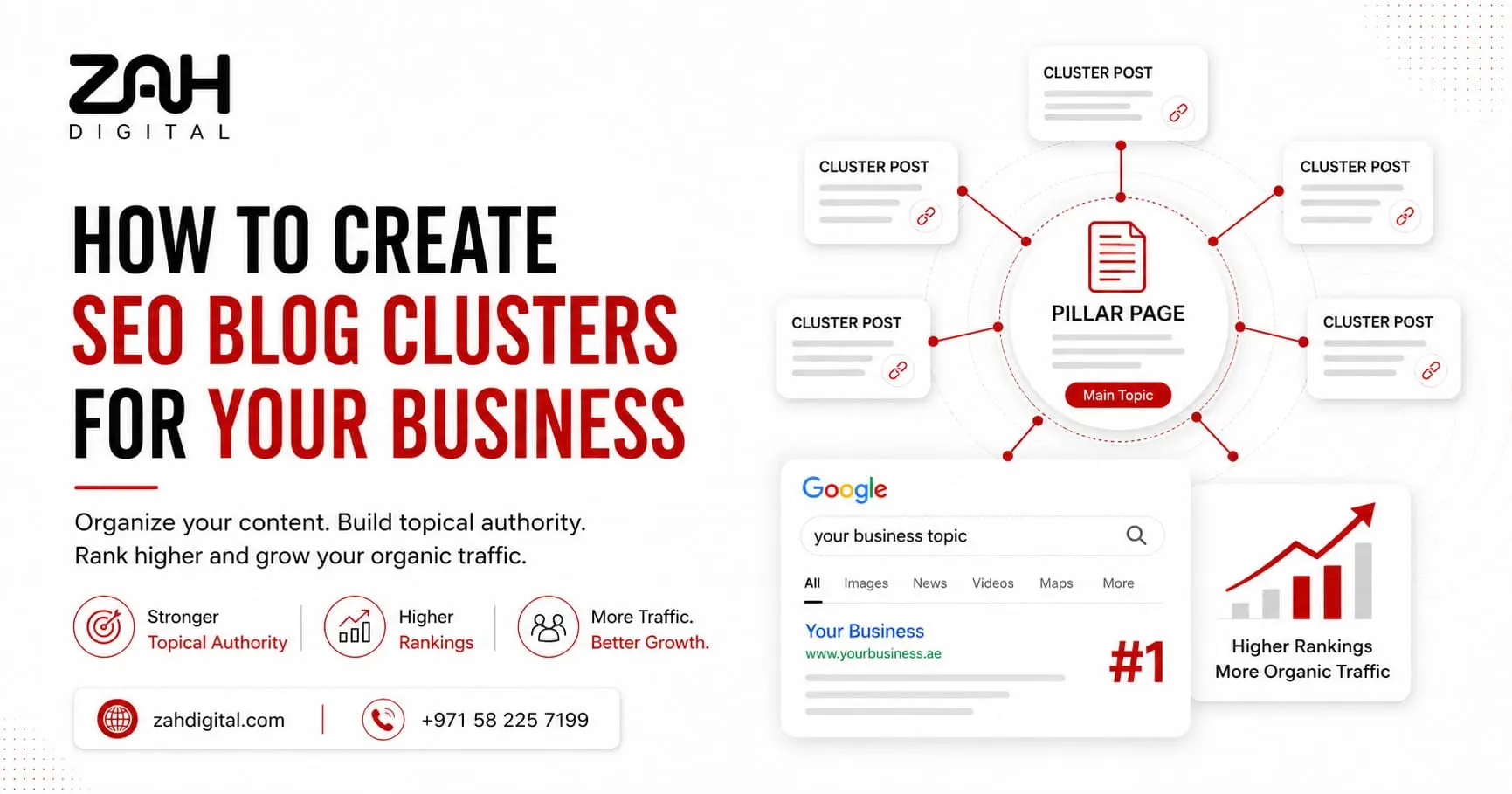
SEO blog clusters are groups of closely related articles connected to one broad, authoritative page. The main resource will cover the topic at a high level. While supporting articles will answer narrower questions in greater detail.
A Dubai accounting firm must create a pillar page about “Corporate Tax Services in the UAE.” Supporting topic clusters can cover registration deadlines. Taxable income. Free-zone rules. Penalties and filing requirements.
These pages will create a clear content silo structure. Rather than a scattered blog archive. Get details on SEO Service in Dubai.
Pillar Content vs. Cluster Content
A strong pillar content strategy gives every page a defined role. The pillar acts as the central guide, whereas cluster pages focus on specific search intentions.
Content Type | Main Purpose | Typical Length | Keyword Focus | Linking Role |
Pillar page | Explain a broad service or subject | 1,500–3,000 words | High-volume topic | Links to all cluster pages |
Cluster page | Answer one focused question | 700–1,500 words | Long-tail keyword | Links back to the pillar |
Service page | Convert interested visitors | 700–1,200 words | Commercial keyword | Receives links from relevant blogs |
FAQ page | Provide quick answers | 40–80 words per answer | Voice and question searches | Supports pillar and service pages |
The goal will not be to produce longer content for the sake of it. But each page must satisfy a distinct search need. Also guide readers towards the next useful step.
How to Choose the Right Pillar Topic
Start with a subject. That sits close to your core service. It must be broad enough to support several articles. But specific enough to attract potential customers.
A useful pillar topic usually meets three conditions:
- It relates directly to a profitable service.
- Customers regularly ask questions about it.
- Search results reveal several connected subtopics.
For instance, “SEO” is too broad for most local agencies. However, “Local SEO for UAE Service Businesses” offers a clearer audience, commercial purpose and cluster direction. Looking for a Local SEO Service in Dubai?
Use Keyword Research to Build Clusters
Next, group keywords by meaning rather than search volume alone. This process, often called keyword clustering, helps you identify searches that belong on the same page and searches that deserve separate articles.
Look at:
- Google autocomplete suggestions
- People Also Ask questions
- Search Console queries
- Competitor headings
- Customer emails and sales enquiries
- Location-based searches
- Comparison and cost-related terms
That said, avoid creating several pages that answer almost the same question. Pages targeting “SEO cost in Dubai” and “how much does SEO cost in Dubai?” may compete against each other. In most cases, one stronger page serves both searches.
Create a Practical Content Map
Before writing. Build a simple content map. Place the pillar topic at the centre. Then add supporting articles around it.
Your map can include informational pages. Comparison posts. Checklists. Pricing guides. Local pages and buyer-focused questions. On top of that, assign a target keyword, search intent, URL and call to action to every page.
This step makes SEO content planning more efficient because writers know exactly what each article must achieve. Get details on AEO Optimization Agency in Dubai.
Build an Internal Linking Strategy
Effective internal linking for SEO will be more than adding random links to old posts. Each cluster article should link naturally to the pillar page. Likewise, the pillar should direct readers towards relevant supporting pages.
Cluster articles can also link to one another when the connection genuinely helps the reader. For example, a post about local keyword research could link to another article about Google Business Profile optimisation.
Use descriptive anchor text. “Learn about local SEO keyword research” gives users and search engines more context than “click here.”
Measure Cluster Performance
Once the cluster goes live, track the full group rather than judging one page in isolation.
Useful metrics include:
- Organic clicks and impressions
- Number of ranking keywords
- Average ranking positions
- Internal link clicks
- Engagement time
- Leads from cluster pages
- Conversions assisted by blog content
A new cluster will not produce enquiries immediately. But if impressions rise from 3,000 to 7,500 over three months. Several articles move onto page one. The structure will be gaining visibility.
Related Services:
» Social Media Marketing Service in Dubai
» CRO & Funnel Optimization Service in Dubai
» Website Development Service in Dubai
» Performance Marketing Agency in Dubai
Common Blog Cluster Mistakes to Avoid
One common mistake is choosing a pillar topic with no commercial connection. Traffic may grow, yet leads remain flat.
Another problem is publishing ten cluster pages and forgetting to link them. Without clear connections. The website will still look fragmented. Likewise keyword stuffing. Duplicated search intent. Also outdated pillar pages will weaken the entire content marketing strategy.
Do not treat blog clusters as a one-time project. Review them regularly. Refresh statistics. Also add new supporting content. When customer behaviour changes.
Related Articles:
» Technical SEO Basics for Business Websites
» What Is On-Page SEO and Why Is It Important?
» How Long Does SEO Take to Show Results?
» SEO Mistakes Dubai Businesses Must Avoid
» What is Search Intent and Why It Matters for SEO?
Build a Search Strategy That Connects Content to Leads
Well-planned topic clusters will help search engines understand your expertise. But they will give customers a smoother path. From question to solution.
ZAH Digital will create research-led content clusters. Pillar pages. Service content. Also internal linking structures for businesses that want more than isolated rankings. Speak with ZAH Digital today. To turn your blog into a connected SEO asset. That attracts qualified traffic and supports real enquiries.
FAQs: How to Create SEO Blog Clusters for Your Business
An SEO blog cluster is a connected group of pages built around one main topic. A broad pillar page introduces the subject, while supporting articles answer related questions. Internal links connect the pages. Helping visitors navigate the content. Also helping search engines recognise the website’s expertise.
Topic clusters improve rankings by showing clear relationships between related pages. When useful articles link to a strong pillar page, search engines receive better context about the website’s subject coverage. This structure will improve crawling. Distribute page authority. Also increase visibility for both broad and long-tail keywords.
A pillar page will cover a broad topic. While a cluster page explores one specific part of that topic. The pillar will act as the central resource. Each cluster article answers a narrower search query. Both pages link to each other to create an organised content structure.
Most SEO topic clusters start with one pillar page and five to fifteen supporting articles. However, the right number depends on the subject, customer questions and available search opportunities. A smaller cluster with useful and distinct pages will usually perform better. Than a large cluster filled with repetitive content.
Choose a pillar topic that closely relates to a key service. Attracts regular customer questions. Also supports several useful subtopics. It should have enough search demand to justify a detailed guide. At the same time, it should be specific enough to attract people who may become customers.
Keyword clustering means grouping search terms. That share the same meaning. Or search intent. Instead of creating a separate page for every keyword variation. You can assign related phrases to one strong page. This will reduce content overlap. Prevents keyword cannibalisation. Also creates a clearer SEO content plan.
Each cluster page must include at least one relevant contextual link to the pillar page. The anchor text must describe the destination naturally. The pillar page must also link back to every cluster article. Allowing readers and search engines to move through the entire topic efficiently.
Yes. Blog clusters can generate leads. When the topics connect directly to customer needs. Also commercial services. Informational pages will attract early-stage visitors. While internal links will guide them towards service pages. Consultations or enquiries. Clear calls to action will help turn educational traffic into qualified business opportunities.
A topic cluster will begin gaining impressions. Within a few weeks. But meaningful ranking growth will often take three to six months. Results will depend on competition. Website authority. Content quality. Technical SEO and backlinks. Regular updates and stronger internal links will help the cluster improve over time.
Most businesses have several services. Products. Or blog categories that will benefit from a content silo structure. It groups related pages in a logical way. Making the website easier to navigate. But the structure must remain flexible. So useful pages can link across categories. When the connection helps users.
Measure cluster success through organic impressions. Clicks. Keyword growth. Rankings. Engagement and conversions. Review the pillar. Also supporting pages as one group. Also track whether visitors move from blog content to service pages. Contact forms. Calls or other meaningful actions.
Yes. ZAH Digital can research. Plan. Write and optimise a complete topic-cluster strategy. For your website. The process will include keyword clustering. Pillar-page creation. Supporting blogs. Content mapping and internal linking. Each cluster is aligned with your services, target locations and customer search behaviour.