

Publishing a few blog posts. Also adding target keywords to service pages will no longer create a strong SEO presence. Search engines will now look at the bigger picture. They want to know whether your website demonstrates real knowledge across an entire subject. Not just one isolated keyword.
That is where topical authority becomes valuable.
A website with strong topical authority will answer the main questions. Supporting questions. Comparisons. Problems. Also buying concerns connected to its core services. So search engines will understand the website’s expertise clearly. Potential customers will receive better answers. Which increases trust. Also encourages enquiries.
What Is Topical Authority in SEO?
Topical authority will refer to the level of expertise. Also coverage a website demonstrates around a specific subject. Instead of creating unrelated pages for high-volume keywords. A topical SEO approach will build a connected library of useful content.
A Dubai accounting company must not publish only a page about bookkeeping services. It must also cover VAT registration. Corporate tax. Payroll. Audits. Financial reporting. Accounting software. Compliance deadlines. Also common business mistakes.
Together, these pages show subject expertise. So Google and AI-driven search platforms will associate the website with accounting-related queries confidently.
Although domain authority will reflect the overall strength of a website. Topical authority will focus on how thoroughly the site covers a particular area. Get details on SEO Service in Dubai.
How Do Keyword Clusters and Pillar Pages Build Authority?
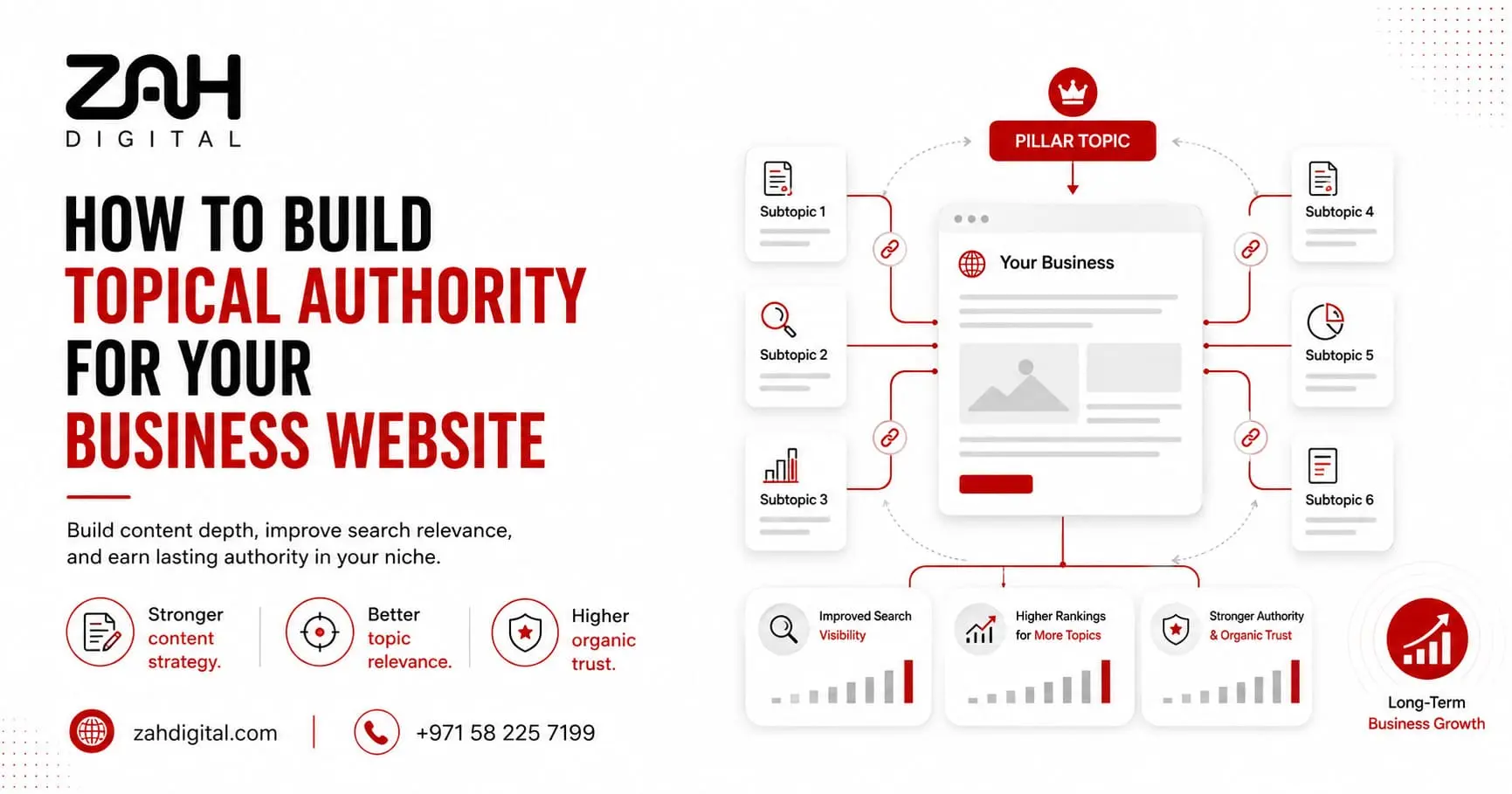
A strong SEO strategy. This will start by organising keywords according to topics and search intent. Rather than treating every keyword as a separate campaign. Group closely related searches into content clusters.
Each cluster should include:
- One detailed pillar content page covering the broad topic
- Comparison. Pricing. Checklist. Also problem-solving content
- Supporting articles answering specific questions
- Commercial service pages connected to relevant searches
A web design agency will create a pillar page about website design. Supporting pages will then cover responsive layouts. Website redesign costs. E-commerce design. Landing pages. WordPress maintenance. Also conversion optimisation.
This structure will help search engines understand the relationship between pages. Users can move naturally from general education to a specific service.
Topical Authority vs Traditional Keyword SEO
SEO Approach | Traditional Keyword SEO | Topical Authority Strategy |
Main focus | Individual keywords | Complete subject coverage |
Content structure | Separate, disconnected pages | Connected content clusters |
User journey | Often ends on one page | Guides users through related topics |
Internal links | Added occasionally | Planned strategically |
Search intent | May target one intent | Covers informational and commercial intent |
Long-term value | Rankings may fluctuate quickly | Builds broader and more stable visibility |
Traditional SEO still has value. However, topical authority strengthens it by connecting keywords, expertise, content quality, and user experience within one structured system.
Why Does Internal Linking Matter?
An effective internal linking strategy will act like a roadmap. It will tell search engines which pages belong together. Also which pages carry the most importance.
Every supporting article should link back to its main pillar page. In addition, the pillar page should direct visitors to detailed resources where they can learn more. Service pages can also connect to educational content that answers common objections.
For example, an article explaining website redesign costs may link to a redesign service page. Similarly, the service page may link to a website audit guide.
Avoid forcing links into unrelated paragraphs. Internal links will work best. When the anchor text clearly describes the destination. Also genuinely helps the reader. Looking for a Local SEO Service in Dubai?
Should You Focus on Content Depth or Breadth?
You will need both. But balance matters.
Content breadth means covering the major subtopics within your business niche. Content depth means answering each subject with useful explanations, examples, steps, and practical advice.
A website with breadth but no depth may publish hundreds of thin articles. On the other hand, a website with depth but limited breadth may answer one topic well while ignoring important related searches.
Start with your most commercially valuable topic. Then create enough supporting content to answer the questions customers ask before, during, and after making a purchase. Once that cluster becomes strong, expand into the next relevant area.
How Do E-E-A-T Signals Support Topical Authority?
Google’s E-E-A-T framework will consider experience and expertise. Authoritativeness and trust. Although E-E-A-T is not a single ranking score. These signals will strengthen how users and search systems evaluate your content.
Add practical experience wherever possible. For instance, include original examples, expert commentary, case studies, client outcomes, process explanations, and industry-specific observations.
Additionally, show who created or reviewed the content. Clear author biographies, accurate company information, contact details, service locations, updated dates, and trustworthy references all support credibility.
For GEO and AEO. Structure will also matter. Direct answers. Descriptive headings. Short definitions. Factual tables. Also clearly labelled FAQs will make your content easier. For AI answer engines to understand and cite.
Related Services:
» CRO & Funnel Optimization Service in Dubai
» Social Media Marketing Service in Dubai
» Website Designing Service in Dubai
» Performance Marketing Agency in Dubai
How Can You Measure Topical Authority Success?
Topical authority does not appear as one number in an SEO tool. Therefore, you need to track several performance indicators together.
Measure:
- Growth in ranking keywords across the topic
- Increased impressions for related searches
- Higher organic traffic to the full content cluster
- More internal page visits per session
- Better rankings for service and commercial pages
- Featured snippets and AI Overview visibility
- Leads generated from supporting content
In fact, one of the clearest signs of progress is when several pages within the same topic begin ranking, rather than only one article gaining traffic.
Related Articles:
» How to Use Search Console for SEO Growth?
» How to Build an SEO Strategy Before Launching a Website?
» How to Create SEO Blog Clusters for Your Business?
» What Is On-Page SEO and Why Is It Important?
» How Long Does SEO Take to Show Results?
Build a Stronger Search Presence with ZAH DIGITAL
Topical authority requires more than publishing extra articles. It needs research. Planning. Structured content. Strong internal links. Also a clear understanding of how your customers search.
ZAH DIGITAL will create practical content clusters. Pillar pages. Service content. Also authority-building SEO plans for businesses. That wants lasting visibility. Whether you need to organise an existing website. Or build a complete content framework from the ground up. Our team will turn scattered pages into a focused search asset.
Contact ZAH DIGITAL. To develop a topical authority strategy that attracts relevant traffic. Strengthens trust. Also converts searches into genuine business opportunities.
FAQs: How to Build Topical Authority for Your Business Website
Topical authority is a website’s demonstrated expertise across a specific subject area. A site builds it by publishing accurate, detailed, and connected content that answers related user questions. Search engines will then understand what the website specialises in. This may rank several of its pages for relevant searches.
Most websites will need several months to show meaningful progress. The timeline will depend on competition. Current website strength. Publishing frequency. Content quality. Backlinks and technical SEO. A focused niche website must improve faster. While a competitive industry will often require a longer and consistent content strategy.
No. Domain authority will generally refer to the overall strength. Also backlink profile of a website. Topical authority will measure how comprehensively. Also credibly the site covers a specific subject. A newer website will develop strong topical authority in a narrow niche. Even without a very high domain authority score.
There will be no fixed number. The right amount will depend on the size of the topic. Also the number of relevant search intents. A small cluster will need five to ten strong pages. While a broad service category will require dozens of interconnected articles. Guides. Comparisons and service pages.
A content cluster is a group of related pages organised around one central topic. It usually includes a detailed pillar page and several supporting articles. Each page will target a specific question. Or search intent. While internal links can connect the cluster. Also help search engines understand the topical relationship.
Pillar content is a comprehensive page. That introduces and explains a broad subject. It will act as the central resource for a content cluster. Supporting articles can explore narrower subtopics. Also link back to the pillar page. This creates a clear structure for both users and search engines.
Yes. Internal linking will connect related pages. Distributes page value. Also helps search engines understand website structure. It will guide users toward useful supporting information. For the best results. Use descriptive anchor text. Also link only to pages that genuinely expand. Or clarify the topic being discussed.
Yes. Service pages will play an important role. Because they connect educational content with commercial intent. A strong topical strategy will link blog posts and guides. FAQs. Case studies and comparison pages to relevant services. This connection will help search engines understand your expertise. Also the solutions your business provides.
Search intent will explain what a user wants. When entering a query. Strong topical authority will require content for different intents. This includes informational and commercial searches. Also transactional and navigational searches. Covering only educational queries will generate traffic. But covering buying and comparison searches will produce stronger business results.
Yes. E-E-A-T signals will support content credibility. By demonstrating experience. Expertise. Authority and trust. Author information. Real examples. Accurate facts. Case studies. Company details. Transparent policies. Also updated content can help both users and search engines feel confident about the information presented.
It will improve the chances. AI search systems favor content that is clear and well-structured. Relevant and supported by strong subject coverage. Direct answers. Meaningful headings. Concise definitions. Tables. FAQs. Also connected topic clusters will make website content easier. For AI platforms to interpret and reference.
Track growth across the entire topic. Not just one keyword. Look for more ranking pages. Increased impressions. Wider keyword coverage. Higher organic traffic. Improved service-page visibility. Stronger user engagement. Also more enquiries. Consistent improvement across several related pages will usually indicate growing topical authority.